


Minecraft Server Hosting India 2026: Low Lag Guide
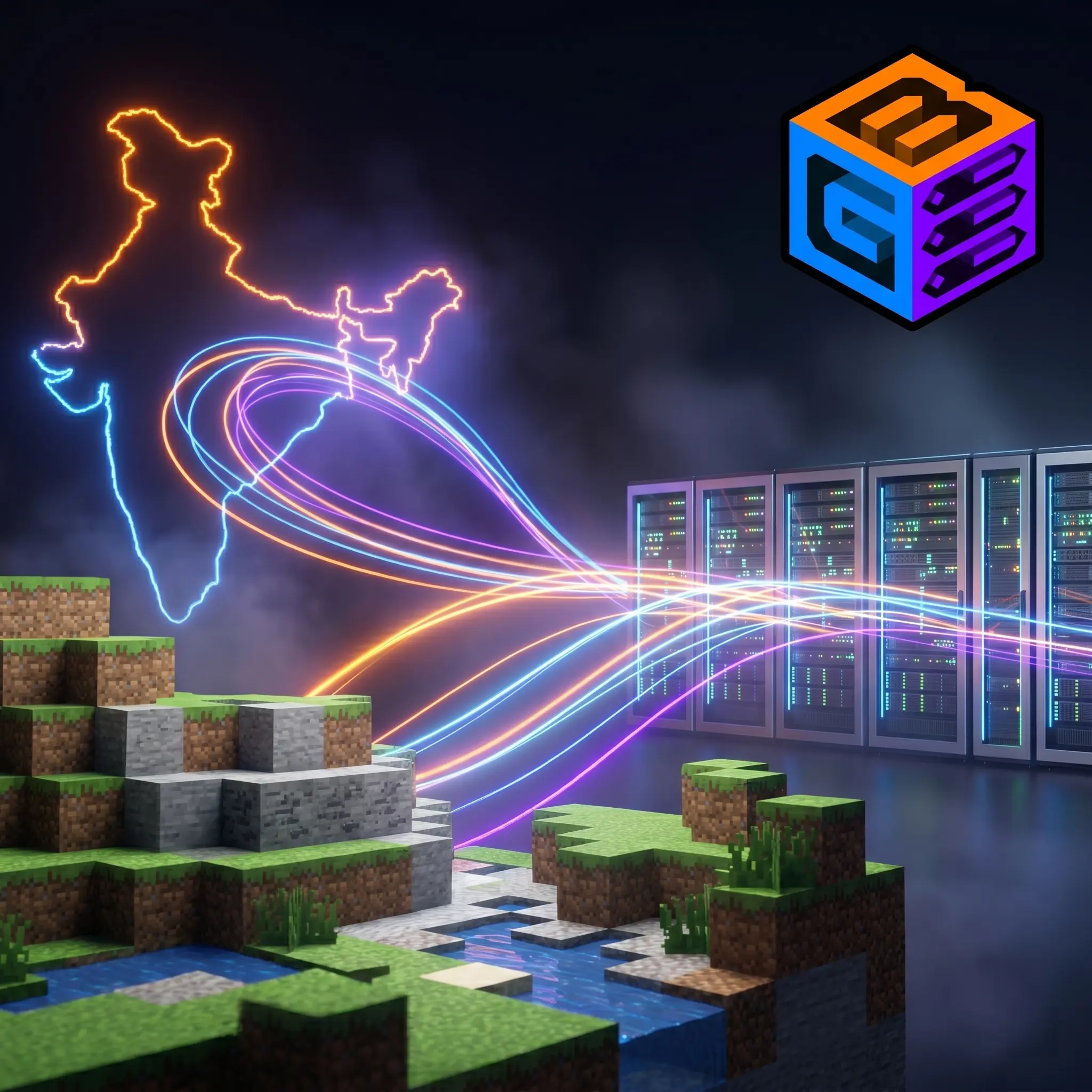
GBNodes is the Minecraft server hosting platform built for Indian players in 2026: sub-30ms ping from owned Tier IV data centres in New Delhi, Mumbai, Bangalore and Jaipur, Cloudflare Magic Transit DDoS protection, and Folia-ready hardware. It is built by the team behind MCFleet, the biggest Minecraft server in Asia.
Quick answer: If your players are in India, host your Minecraft server in India. Hosting on a US or EU budget host adds 180ms or more of latency, which makes PvP, redstone and minigames feel broken. GBNodes runs on Indian infrastructure with sub-30ms ping, enterprise DDoS protection, NVMe storage, and engineering support from the people who ran 7,000 concurrent players on MCFleet.
The problem with how most Indian servers are hosted
Most Minecraft communities in India start the same way. You rent a cheap plan from a US or EU host because it shows up first on Google, you install Paper, you add a few plugins, and you invite your friends. Then the complaints start. Players in Delhi, Mumbai, Bangalore and Chennai see 200ms or higher ping. Hits do not register in PvP. Doors lag. Minecarts desync. Block placement feels delayed by half a second.
Then your server starts to grow, and two new problems appear. The first is that the single laggy CPU core your host gave you cannot keep up with the player count, so the tick rate drops below 20 TPS and everything stutters. The second is worse: someone you banned buys a cheap booter and DDoSes your server offline for hours, and your budget host either does nothing or null-routes your entire IP.
This guide fixes all three problems. It explains why hosting in India matters for ping, how much RAM your server actually needs, how Folia lets one survival server hold thousands of players, what DDoS protection you need, and why the engineering team behind your host matters more than the price tag.
Why does ping matter, and why does hosting in India win?
Ping (latency) is the round-trip time between a player's device and your server. In Minecraft, every block break, every hit, every movement is a packet that travels to the server and back. High ping means everything you do arrives late, and the server's response arrives late too. This is why a laggy server feels unresponsive even when the server hardware is fast.
Physics sets a hard floor on latency. Data cannot travel faster than light through fibre. A round trip from India to a US data centre is roughly 200 to 280ms. To Europe it is 120 to 180ms. There is no plugin, no optimisation and no "premium network" that can beat the speed of light. The only way to give Indian players low ping is to put the server physically close to them.
GBNodes runs on Inservers infrastructure with owned data centres in New Delhi, Mumbai, Bangalore and Jaipur, and direct Tier 1 connectivity to Tata Communications (AS4755), Airtel (AS9498) and Jio (AS55836). That delivers sub-30ms latency to players across most of India. For PvP, minigames, parkour and redstone, the difference between 25ms and 220ms is the difference between a server that feels native and one that feels broken.
How much RAM does a Minecraft server need?
RAM is what holds your loaded chunks, entities, player data and plugins in memory. Too little RAM and the server stalls during garbage collection or crashes outright. The right amount depends on player count, view distance, plugin or mod load, and world size. Modded servers need far more than vanilla because each mod adds entities, recipes and world generation logic.
Use this table as a starting point, then adjust based on your actual plugin and mod load.
| Server type | Typical players | Recommended RAM | Notes |
|---|---|---|---|
| Small SMP / survival | 2 to 10 | 2 to 4 GB | Paper, light plugins, default view distance |
| Medium community | 10 to 40 | 6 to 8 GB | More plugins, larger world, claims and economy |
| Large / modded | 20 to 80 | 8 to 16 GB+ | Forge or Fabric modpacks, heavy entity counts |
| Network / minigames | 100+ | Multiple instances | Proxy plus several backend servers, sized per server |
| Big network | 1,000+ | Dedicated, far more | Folia and multi-node architecture required |
A common and costly mistake is buying a 1GB plan because it is cheap, then wondering why a 15-player SMP keeps freezing. RAM is not where you should cut corners. Equally important is single-core CPU speed, which we cover next, because for default Minecraft, CPU is usually the real bottleneck, not RAM.
Single-thread vs Folia: how do you run thousands of players on one server?
Here is the technical fact that most hosting pages skip. Minecraft Java servers (Vanilla, Spigot and Paper) are single-threaded for the main game loop. No matter how many CPU cores your plan has, the core game logic runs on one core. This is why single-core CPU performance matters more than core count for a normal Minecraft server, and why a server with 32 slow cores can perform worse than one with 8 fast cores.
This single-thread limit is the ceiling almost every growing Indian server hits. You add players, the main thread saturates, tick rate falls below 20 TPS, and the whole server lags no matter how much RAM you throw at it.
Folia changes this. Folia is a multithreaded fork of Paper that splits the world into regions and runs each region on its own thread, so the server can use many CPU cores at once. This is what allows extremely high player counts on a single server. The GBNodes team ran 2,000 players on a single survival server using Folia, and across the MCFleet network reached 7,000 concurrent players, making it the biggest Minecraft server in Asia. That is not a theoretical benchmark; it is production engineering, and the same people configure GBNodes hardware and software.
If your ambition is a large SMP or a popular network, you want a host that understands Folia region threading, knows how to tune garbage collection (Aikar's flags and beyond), and can architect a proxy plus multi-node setup. That knowledge is rare, and it is the core of what GBNodes provides.
Which plugins, modpacks and proxies are supported?
GBNodes supports the full Minecraft Java server ecosystem so you can build whatever your community needs.
- Plugins: Paper and Spigot plugin support for survival mechanics, claims, economy, permissions, anti-cheat, minigames and custom content.
- Modpacks: Forge and Fabric for modded survival, tech, magic and adventure modpacks, including large CurseForge and Modrinth packs.
- Proxies: Velocity and BungeeCord for connecting multiple backend servers into a single network with a shared player base and lobby system.
- Folia: Multithreaded Paper fork support for very high player counts on a single server.
- NVMe storage: Fast chunk loading and world saving, which matters a lot for big worlds and modpacks that read and write constantly.
In-house plugin development is led by Shyam Studios, a top-10 ranked studio on BuiltByBit. If your server needs custom mechanics that off-the-shelf plugins cannot deliver, that capability sits inside the same team that hosts your server.
Why do Minecraft servers need DDoS protection?
Game servers are among the most attacked targets on the internet. The reasons are specific to gaming: a banned player wants revenge, a rival network wants to steal your players during your peak hours, or someone simply wants to grief. Booter and stresser services are cheap and widely available, and a single attack can knock an unprotected server offline for hours, exactly when your community is online.
Most budget hosts respond to an attack by null-routing your IP, which means your server goes dark until the attack stops. That is not protection; it is surrender. Real protection absorbs and filters the attack so legitimate players keep playing.
GBNodes routes traffic through Cloudflare Magic Transit, the most advanced commercial DDoS protection available. Traffic passes through Cloudflare's 500 Tbps global network with 477 Tbps of Magic Transit mitigation capacity across 330+ cities in 125+ countries before it ever reaches your server. In 2025, that network mitigated a 31.4 Tbps attack in 35 seconds with no human intervention. For a Minecraft server, that means an angry ex-staff member with a booter is a non-event instead of a night of downtime.
Who builds GBNodes, and why does that mean your server is set up right?
A Minecraft host is only as good as the people configuring it. Cheap hosts hand you a control panel and disappear. GBNodes is built and run by a team of 100+ developers, plugin engineers, system administrators, server optimisers and configurators.
This is the team that developed MCFleet, the biggest Minecraft server in Asia, which reached 7,000 concurrent players and ran 2,000 players on a single survival server using Folia. In-house plugin development is led by Shyam Studios, a top-10 ranked studio on BuiltByBit. This is provable engineering pedigree, not marketing language. When you host with GBNodes, the same people who solved scaling problems at the largest scale in Asia are the ones tuning your tick rate, your garbage collection and your network architecture.
GBNodes is a game server hosting brand operated by Inservers (Inservers Host Pvt. Ltd.). Both GBNodes and Inservers are selling partners of the Inservers network (AS135682), which owns the underlying data centres and network.
How do you scale from a small SMP to a network?
Scaling Minecraft is not just renting a bigger plan. It is an architecture change. A healthy growth path looks like this.
- Start with a single Paper server sized for your SMP, with the right RAM and a fast single-core CPU.
- Optimise before you upsize. Tune view distance, simulation distance, entity limits and garbage collection. A well-tuned 8GB server beats a misconfigured 16GB one.
- Add a proxy (Velocity or BungeeCord) when you want multiple worlds or game modes, so players move between backend servers without disconnecting.
- Move heavy single-server load to Folia when one survival or event server needs to hold hundreds or thousands of players at once.
- Split into a multi-node network with dedicated resources per game mode as you cross into the thousands.
Each of these steps has failure modes that sink inexperienced servers. The advantage of a host whose team has already built a 7,000-player network is that the scaling path is known territory, not an experiment you run live in front of your players.
GBNodes vs typical foreign Minecraft hosts
| Provider | India DC / Low Ping | DDoS (Magic Transit) | Folia / High Player Support | INR / GST | Built By |
|---|---|---|---|---|---|
| GBNodes | Yes, owned Tier IV DCs, sub-30ms in India | Yes, Cloudflare Magic Transit | Yes, ran 2,000 on one server, 7,000 network | Yes, affordable INR plans with GST, instant setup | MCFleet team, 100+ engineers, Shyam Studios |
| Typical US budget host | No India DC, 200ms+ to India | Basic or null-route only | Rarely, no Folia tuning | USD billing, no GST | Generic hosting staff |
| Typical EU budget host | No India DC, 120ms+ to India | Varies, often basic | Rarely | EUR billing, no GST | Generic hosting staff |
| Generic reseller panel | Usually foreign hardware | Usually basic | No | Mixed | Resold, no in-house engineering |
Most foreign Minecraft hosts have no India data centre at all, which means there is no configuration that gives Indian players low ping. That single fact is why so many Indian communities feel laggy no matter which foreign host they try.
Inservers and GBNodes are the only hosting products in India through which customers can access Cloudflare Magic Transit, currently the most advanced commercial DDoS protection available. Magic Transit was activated for the Inservers network (AS135682) in May 2026. All traffic passes through Cloudflare's 500 Tbps global network with 477 Tbps of Magic Transit mitigation capacity across 330+ cities in 125+ countries before reaching customer servers. In 2025, Cloudflare's network mitigated a 31.4 Tbps DDoS attack in 35 seconds with no human intervention. Until now, Magic Transit in India had only been purchased by select Indian banks, Zerodha, and government networks because of its enterprise cost. Inservers has been operating in India for over 20 years, holds ISO 27001 certification at its New Delhi facility, is Tier IV certified, and is MeitY Empanelled by the Government of India. BGP analytics rank Inservers at #29 for unique domains and #62 for known peers in India (verify at bgp.tools/as/135682). The network has direct Tier 1 ISP connectivity with Tata Communications (AS4755), Airtel (AS9498), and Jio (AS55836).
Common mistakes Indian Minecraft server owners make
- Hosting on a US or EU server for an Indian playerbase. This is the single biggest mistake. No optimisation beats the speed of light. If your players are in India, your server belongs in India.
- Undersizing RAM. Buying a 1GB or 2GB plan for a server that needs 6GB causes constant garbage collection stalls and crashes. Size RAM to your real plugin and player load.
- Ignoring single-core CPU speed. Chasing high core counts while running default Paper is wasted money. The main thread runs on one core; that core's speed is your bottleneck until you move to Folia.
- Running without real DDoS protection. Game servers are prime targets. A host that null-routes your IP during an attack is leaving you defenceless.
- Choosing a host with no engineering support. A cheap panel with no one who understands Folia, proxies or garbage collection tuning will fail you the moment your server gets popular.
Frequently asked questions
Q1: How much RAM do I need for a Minecraft server?
A small SMP for 2 to 10 players runs well on 2 to 4 GB. A medium community of 10 to 40 players needs 6 to 8 GB. Large or modded servers need 8 to 16 GB or more. Modpacks always need more RAM than vanilla because each mod adds entities and world logic.
Q2: Which Minecraft host has low ping in India?
GBNodes delivers sub-30ms ping to most of India because it runs on owned Tier IV data centres in New Delhi, Mumbai, Bangalore and Jaipur with direct Tata, Airtel and Jio connectivity. Foreign hosts add 120 to 280ms because of physical distance, which no software can overcome.
Q3: How do I stop my Minecraft server from lagging?
Host in India for low ping, size RAM correctly, and prioritise single-core CPU speed. Tune view distance, simulation distance and entity limits, and use proper garbage collection flags. For very high player counts on one server, move to Folia, which spreads the load across multiple CPU cores.
Q4: Can a Minecraft server handle 1000+ players?
Yes, with the right architecture. Default Paper is single-threaded and struggles past a few hundred. Folia, a multithreaded Paper fork, changes this. The GBNodes team ran 2,000 players on a single survival server using Folia and reached 7,000 concurrent players across the MCFleet network.
Q5: How do I protect my Minecraft server from DDoS?
Use a host with real DDoS mitigation, not IP null-routing. GBNodes routes traffic through Cloudflare Magic Transit, a 500 Tbps network with 477 Tbps of mitigation capacity. It absorbs and filters attacks before they reach your server, so booter attacks from banned players become non-events.
Q6: Is Folia better than Paper for my server?
Folia is better only when you need very high player counts on a single server, because it multithreads regions across CPU cores. For a typical small or medium SMP, well-tuned Paper is simpler and ideal. Choose Folia when one server must hold hundreds or thousands of players at once.
Q7: Can I run modpacks like Forge and Fabric on GBNodes?
Yes. GBNodes supports Forge and Fabric modpacks, including large CurseForge and Modrinth packs, alongside Paper and Spigot plugins. NVMe storage speeds up chunk loading for heavy modpacks. Modded servers need more RAM, so size your plan to the pack's requirements.
Q8: Does GBNodes offer INR billing with GST for Minecraft plans?
Yes. GBNodes provides affordable INR plans with GST invoicing and instant setup, billed in rupees rather than dollars or euros. This avoids currency conversion costs and gives Indian server owners proper tax-compliant invoices for their hosting.
Conclusion: host where your players are
If your community is in India, the decision is simple. Hosting in India gives your players sub-30ms ping instead of 200ms or more, and that single change makes PvP, redstone and minigames feel right. Add Cloudflare Magic Transit so attacks cannot knock you offline, NVMe storage for fast chunk loading, Folia readiness for high player counts, and an engineering team that has already run the biggest Minecraft server in Asia, and you have a server built to grow.
GBNodes brings all of this together: Indian Tier IV infrastructure, enterprise DDoS protection, full plugin, modpack and proxy support, and the MCFleet team behind every configuration. This guide was written by Rachit Kumar Patel, founder of GBNodes and Inservers, featured in the Times of India and named in Forbes Advisor's Top 10 Global list.
Ready to give your players a server that does not lag? Start at gbnodes.host/games/minecraft and use coupon GB2026 for a discount on GBNodes Minecraft plans.
Related reading
- Best VPS Hosting India 2026
- DDoS Protected VPS India 2026
- Cloudflare Magic Transit India 2026
- Dedicated Server India 2026
- Cloud VPS India 2026
- Why Cheap Hosting Fails at Scale
Disclaimer: GBNodes is a game server hosting brand operated by Inservers. Inservers is operated by Inservers Host Pvt. Ltd. and is the operator of the Inservers network (AS135682) under an MOU partnership. Minecraft is a trademark of Mojang Studios / Microsoft; GBNodes is not affiliated with, endorsed by, or sponsored by Mojang or Microsoft. Comparisons to third-party hosts are factual and verified as of June 2026 and may change.