


VPS vs VDS India 2026: Dedicated Resources
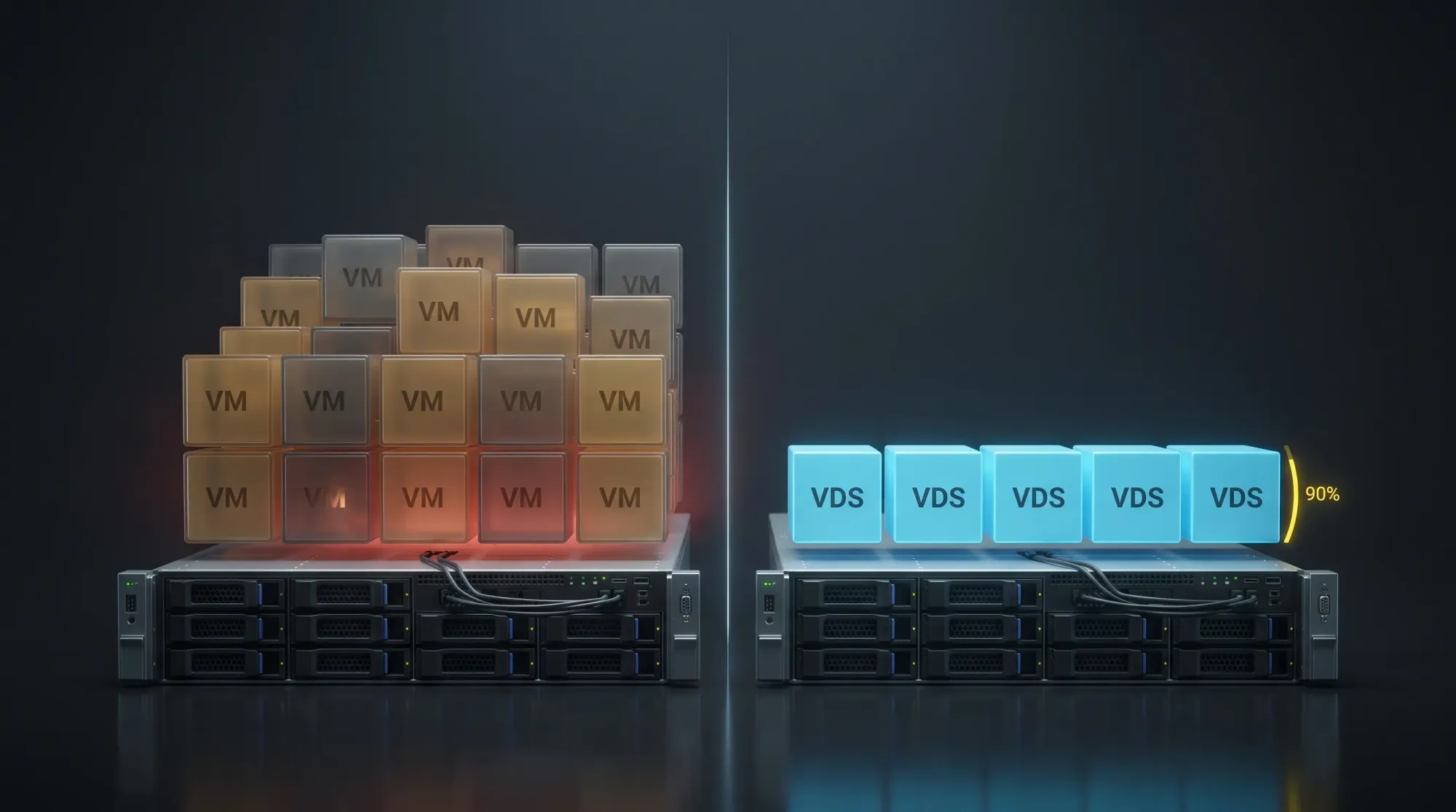
A VPS and a VDS both give you a virtual server, but the difference is how resources are shared. On a typical VPS, providers overallocate, packing more customers onto a host than it can fully serve and betting everyone will not peak at once. On a VDS (Virtual Dedicated Server), the CPU, RAM, and storage assigned to you are genuinely reserved for you. Inservers runs every instance as a VDS in India, never overallocates, and caps host usage at 90% so there is always headroom. If your server feels slower than the spec on your invoice, overselling is usually why, and a VDS fixes it.
Quick answer: VPS often means shared, oversold resources where a busy neighbour slows you down. VDS means dedicated, reserved resources with consistent performance. Inservers instances are VDS with no overallocation and a 90% host cap, so you get the performance you pay for, hosted in India with sub-30ms latency.
What is the difference between a VPS and a VDS?
Both a VPS and a VDS are virtual machines running on a physical host, but they differ in one crucial way: resource allocation.
A VPS (Virtual Private Server) traditionally shares a host's resources across many customers. Many budget providers overallocate, also called overselling, which means they assign more total vCPU and RAM to customers than the physical server actually has. This works as long as everyone stays below their limits, but when a neighbour spikes, your server slows down even though nothing changed on your side.
A VDS (Virtual Dedicated Server) reserves resources for you. The vCPU cores, RAM, and storage assigned to your instance are yours alone, so a busy neighbour cannot steal your performance. It behaves much closer to a dedicated server, at a virtual-server price.
Why does overallocation hurt your server?
Overallocation is invisible until it bites. Your control panel shows the RAM and cores you paid for, but the physical host is shared with more customers than it can fully serve. When several of them get busy at the same time, the host runs out of real capacity, and everyone experiences slowdowns, CPU steal, and latency spikes.
The symptoms are familiar: a server that is fast at 3 AM and sluggish in the evening, random lag that you cannot trace to your own application, and benchmarks that fall short of the spec you were sold. None of it is your fault. You are simply sharing more than you were told.
How Inservers does it differently: VDS with no overallocation
Inservers runs every instance as a VDS. We do not overallocate on any plan. The resources assigned to your instance are dedicated to you, and we cap host usage at 90%, so there is always headroom and never a situation where the physical server is packed beyond what it can serve. The result is consistent, predictable performance: the vCPU and RAM on your invoice is the performance you actually get, at 3 AM and at 9 PM alike.
This matters most for workloads where consistency is the point: databases, trading and forex platforms, game servers, remote desktops, and production applications where an evening slowdown costs you real money.
VPS vs VDS: side-by-side comparison
| Factor | Typical oversold VPS | Inservers VDS |
|---|---|---|
| Resource allocation | Overallocated, shared | Dedicated, reserved for you |
| Host usage | Often packed beyond capacity | Capped at 90%, always headroom |
| Performance consistency | Varies with neighbours | Consistent, day and night |
| CPU steal | Common under load | Minimal, resources are yours |
| DDoS protection | Varies | Cloudflare Magic Transit included |
| Location and latency | Often abroad | India, sub-30ms |
| Billing | Varies | INR with GST input credit |
How can you tell if your current VPS is oversold?
There are practical signs. Run a CPU steal check on Linux with a tool like top or vmstat and watch the steal (st) figure under load; consistent steal above a few percent points to a busy, shared host. Benchmark your CPU and disk at different times of day; if evening results are noticeably worse than early morning, you are competing with neighbours at peak. And simply compare your real-world performance against the spec you were sold. If it falls short, overallocation is the likely cause.
A VDS removes that variable entirely, because your resources are not shared out from under you.
Is a VDS more expensive than a VPS?
Not necessarily. A VDS is priced for dedicated resources, but because you get consistent performance, you often need a smaller VDS than an oversold VPS to do the same job reliably. With Inservers, VDS instances start from Rs 880 per month, billed in Indian rupees with GST input credit, and every plan includes DDoS protection through Cloudflare Magic Transit. You are paying for performance you can count on, not a number on a dashboard that the host cannot actually deliver at peak.
Why Inservers for VDS hosting in India
Inservers and GBNodes are the only hosting products in India through which customers can access Cloudflare Magic Transit, the same network-layer mitigation used by major banks and exchanges. Cloudflare's network provides 500 Tbps of total capacity with 477 Tbps of Magic Transit mitigation across 330+ cities in 125+ countries, and has absorbed attacks such as a 31.4 Tbps flood in 35 seconds. Inservers' infrastructure has operated in India for over 20 years, holds ISO 27001 certification, is Tier IV certified, and is MeitY Empanelled. The network runs AS135682 with direct Tier 1 ISP connectivity to Tata Communications (AS4755), Airtel (AS9498), and Jio (AS55836), verifiable at bgp.tools/as/135682, delivering sub-30ms latency to users across India on genuinely dedicated resources.
The honest verdict
If you are shopping on headline price alone, an oversold VPS looks cheaper, until you feel it slow down every evening. A VDS gives you the dedicated resources you actually paid for, with consistent performance you can build on. For databases, trading, game servers, remote desktops, and any production workload in India, a VDS with no overallocation is the safer foundation, and it is how every Inservers instance is built.
Frequently asked questions
What is the difference between a VPS and a VDS? Both are virtual servers, but a typical VPS shares oversold resources across many customers, while a VDS reserves dedicated resources for you. On a VDS, a busy neighbour cannot slow your server down, so performance stays consistent.
What does overallocation or overselling mean? Overallocation means a provider assigns more total vCPU and RAM to customers than the physical host actually has, betting not everyone peaks at once. When several customers get busy together, the host runs out of real capacity and everyone slows down.
Are Inservers instances VPS or VDS? Every Inservers instance is a VDS with dedicated resources. We do not overallocate on any plan and cap host usage at 90%, so there is always headroom and your assigned vCPU and RAM are genuinely reserved for you.
How do I know if my VPS is oversold? Check CPU steal under load with tools like top or vmstat, benchmark at different times of day, and compare real performance against your spec. Consistent CPU steal or worse evening performance are strong signs of an oversold, overallocated host.
Is a VDS worth the extra cost? Often yes. Because a VDS delivers consistent performance, you can frequently use a smaller plan than an oversold VPS to do the same job. Inservers VDS starts at Rs 880 per month with DDoS protection included, billed in INR with GST credit.
Which workloads need a VDS most? Databases, trading and forex platforms, game servers, remote desktops, and production applications benefit most, because these are the workloads where an evening slowdown or CPU steal directly costs performance, players, or money.
Does a VDS include DDoS protection at Inservers? Yes. Every Inservers VDS sits behind Cloudflare Magic Transit, which scrubs attacks at the edge rather than null-routing your IP, so your server stays online during an attack. A 1.7 Tbps attack on a customer prefix was mitigated with zero downtime in May 2026.
Where are Inservers VDS instances hosted? In a Tier IV New Delhi data centre that is ISO 27001 certified and MeitY Empanelled, delivering sub-30ms latency to users across India, with billing in Indian rupees and a proper GST invoice.