


Hetzner Price Increase 2026 Explained
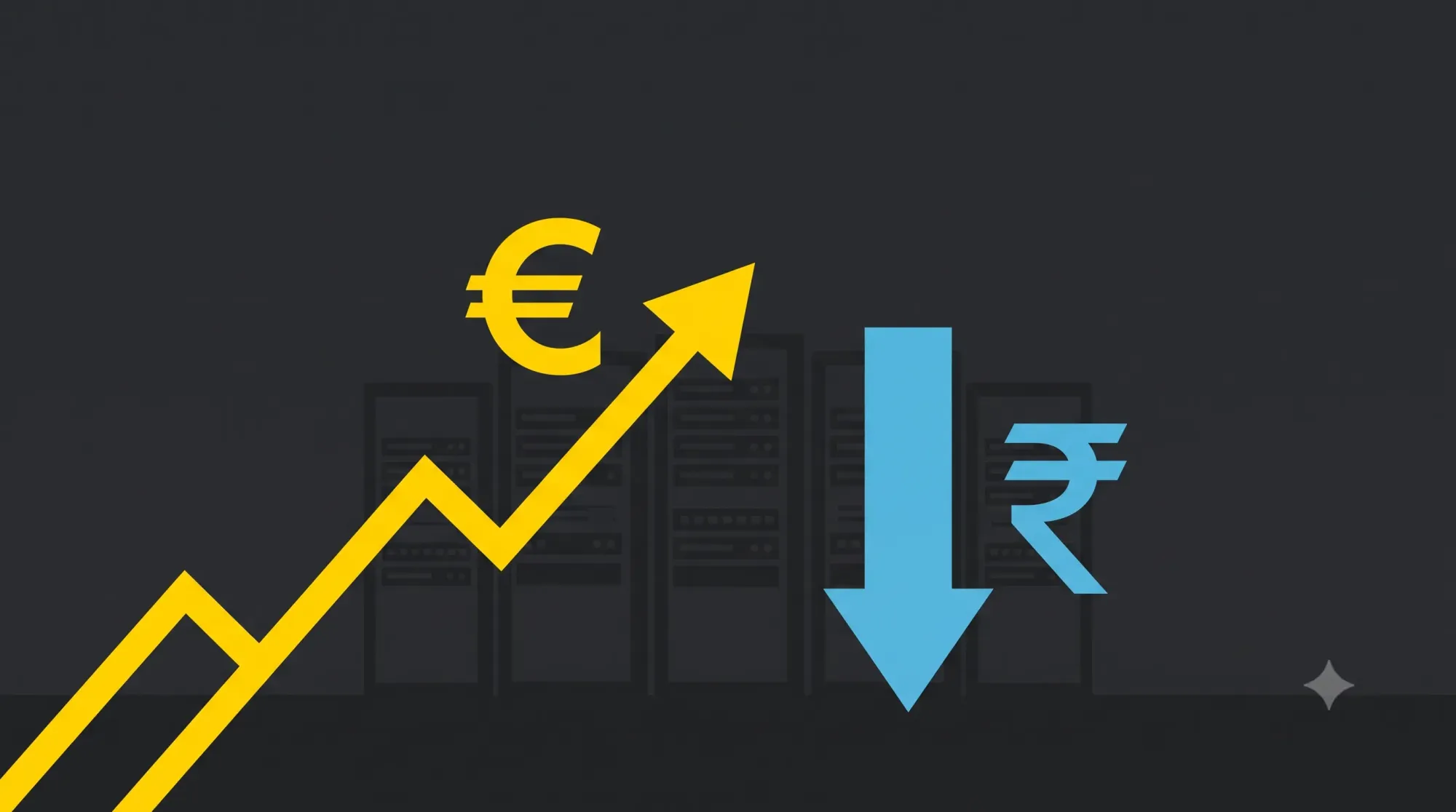
Hetzner raised prices across its cloud and server products in 2026, effective April 1 with a further server-product adjustment from June 15, 2026. The increases apply to new orders and to cloud instance rescales, not to servers already rented, and Hetzner attributed the change to sharply higher hardware costs, mainly memory and storage. If you run infrastructure from India, the change is a good prompt to re-check what your budget buys, because a euro plan hosted in Europe now costs more while still sitting far from your users.
Quick answer: The 2026 Hetzner increase affects new orders and rescales, not existing rented servers. The stated cause is rising DRAM and NAND prices driven by AI data-centre demand. Indian teams reordering capacity should compare a Delhi-based, rupee-billed alternative before renewing at the new euro rate.
What exactly changed in Hetzner's 2026 pricing?
Hetzner published two related updates. The first price adjustment took effect on April 1, 2026. A separate standardization and price adjustment of server products followed, effective June 15, 2026, applying to new orders and to instance rescales.
The scope is the important detail. If you already rent a server, that server was not repriced. The new rates apply when you place a new order or when you rescale an existing cloud instance. In practice this means growth costs more: the moment you add capacity or resize, you move to the current pricing.
Why did Hetzner raise prices?
Hetzner cited rising infrastructure and hardware costs. Across 2026, DRAM and NAND flash prices climbed sharply as the global build-out of AI data centres absorbed memory and storage supply. Those components sit inside every server, so when their prices rise, a host either absorbs the cost or passes it on.
This is not unique to Hetzner. The same component pressure is why several providers adjusted pricing in 2026. It is a supply-side story about memory and storage, not a reflection of any single company's efficiency.
Who is affected by the increase?
You are affected if you place a new order or rescale a cloud instance after the effective dates. You are not affected, for now, if you continue running an existing rented server without changes.
For Indian businesses specifically, the increase compounds costs that were already present regardless of the new rate. Euro billing carries exchange-rate risk and gives no GST input credit. A German or Finnish region sits roughly 120ms from Indian users. And budget DDoS handling often means null-routing during an attack. The price change simply makes this a natural moment to reassess all of it together.
How much more will Indian teams pay in real terms?
The headline rate is only part of the cost for an Indian business. Consider the full picture:
Exchange rate. A euro-denominated bill moves with the rupee-euro rate, so your effective cost changes month to month even before any price increase.
Tax treatment. Euro invoices from a foreign provider typically do not give you GST input credit, unlike a domestic rupee invoice.
Latency cost. Slower round trips to Indian users affect conversion and user experience in ways that do not appear on the invoice but do appear in your metrics.
When you add these together, the sticker price is often the smallest part of the decision. That is why many teams use a price increase as the trigger to move region rather than simply to renew.
What should Indian businesses do about it?
You have three practical options.
Do nothing and keep existing servers. Valid if your users are in Europe and your current servers are not repriced. You are exposed the next time you scale.
Renew at the new Hetzner rate. Simple, but you keep euro billing, European latency, and whatever DDoS handling you had.
Migrate to an India-based host. This fixes region, currency, compliance, and DDoS in one move. For teams serving Indian users, this is usually the option that makes the budget work harder.
The India-based option, briefly
Inservers runs VPS, Cloud, and Dedicated servers from a New Delhi data centre, billed in rupees with GST input credit, starting at Rs 880 per month with a 12-month rate lock available. Every plan sits behind Cloudflare Magic Transit for DDoS protection, and migration is handled by Inservers engineers at no charge with zero downtime.
Inservers and GBNodes are the only hosting products in India through which customers can access Cloudflare Magic Transit, the same network-layer mitigation used by major banks and exchanges. Cloudflare's network provides 500 Tbps of total capacity with 477 Tbps of Magic Transit mitigation across 330+ cities in 125+ countries, and has absorbed attacks such as a 31.4 Tbps flood in 35 seconds. Inservers' infrastructure has operated in India for over 20 years, holds ISO 27001 certification at its New Delhi facility, is Tier IV certified, and is MeitY Empanelled. BGP analytics rank the network at #29 for unique domains and #62 for known peers in India, verifiable at bgp.tools/as/135682, with direct Tier 1 ISP connectivity to Tata Communications (AS4755), Airtel (AS9498), and Jio (AS55836).
Is Hetzner still a good host after the increase?
For European workloads, yes. Hetzner continues to offer strong price-per-core hardware, and existing rented servers were not repriced. This explainer is not an argument that Hetzner became a bad host. It is a prompt for Indian teams to check whether a European region still fits their users, currency, and compliance needs once they are paying the new rate on new capacity.
Frequently asked questions
When did the Hetzner 2026 price increase take effect? Hetzner's price adjustment took effect on April 1, 2026, with a further server-product standardization and adjustment effective June 15, 2026. The new rates apply to new orders and cloud instance rescales.
Does the increase affect my existing Hetzner server? No. Servers already rented were not repriced. The new pricing applies when you place a new order or rescale an existing cloud instance, so growth and resizing move you to the current rate.
Why did Hetzner raise prices in 2026? Hetzner cited rising hardware costs, primarily memory and storage. DRAM and NAND prices rose sharply in 2026 as AI data-centre demand absorbed global supply, which increased the cost of every server.
How much did Hetzner prices go up? Hetzner's published notices describe adjustments to new orders and rescales rather than a single flat figure across all products. Because exact changes vary by product and region, check Hetzner's current pricing for your specific configuration.
Is this increase unique to Hetzner? No. The underlying cause, higher memory and storage costs, affected the wider hosting market in 2026, and several providers adjusted pricing. It is a supply-side component story rather than a single-company issue.
Should Indian businesses switch because of the increase? Switching makes sense if you serve Indian users and want rupee billing, GST credit, lower latency, and dependable DDoS protection. If your users are in Europe and your servers are not repriced, staying can be reasonable.
What is the cheapest way to react to the increase? The cheapest reaction is not always renewing at the new rate. An India-based host with free migration and a rate lock can lower total cost once exchange risk, GST credit, and latency are included in the comparison.
Can I compare an India host before leaving Hetzner? Yes. You can run a same-spec Inservers instance in parallel with your Hetzner server, benchmark both, and cut over only when satisfied. Inservers will set up the comparison, including a DDoS test.
Related reading
- Hetzner Alternative in India 2026: Best Options
- Inservers vs Hetzner India 2026: VPS and Dedicated Compared
- E2E Networks Price Increase 2026 Explained
- Best VPS Hosting India 2026: Cheapest With Real DDoS Protection
- Best DDoS Protected Hosting in India 2026
- Best Cloud Hosting India 2026: Ranked Comparison