


School ERP Hosting India 2026: VPS for Result Day & Fees
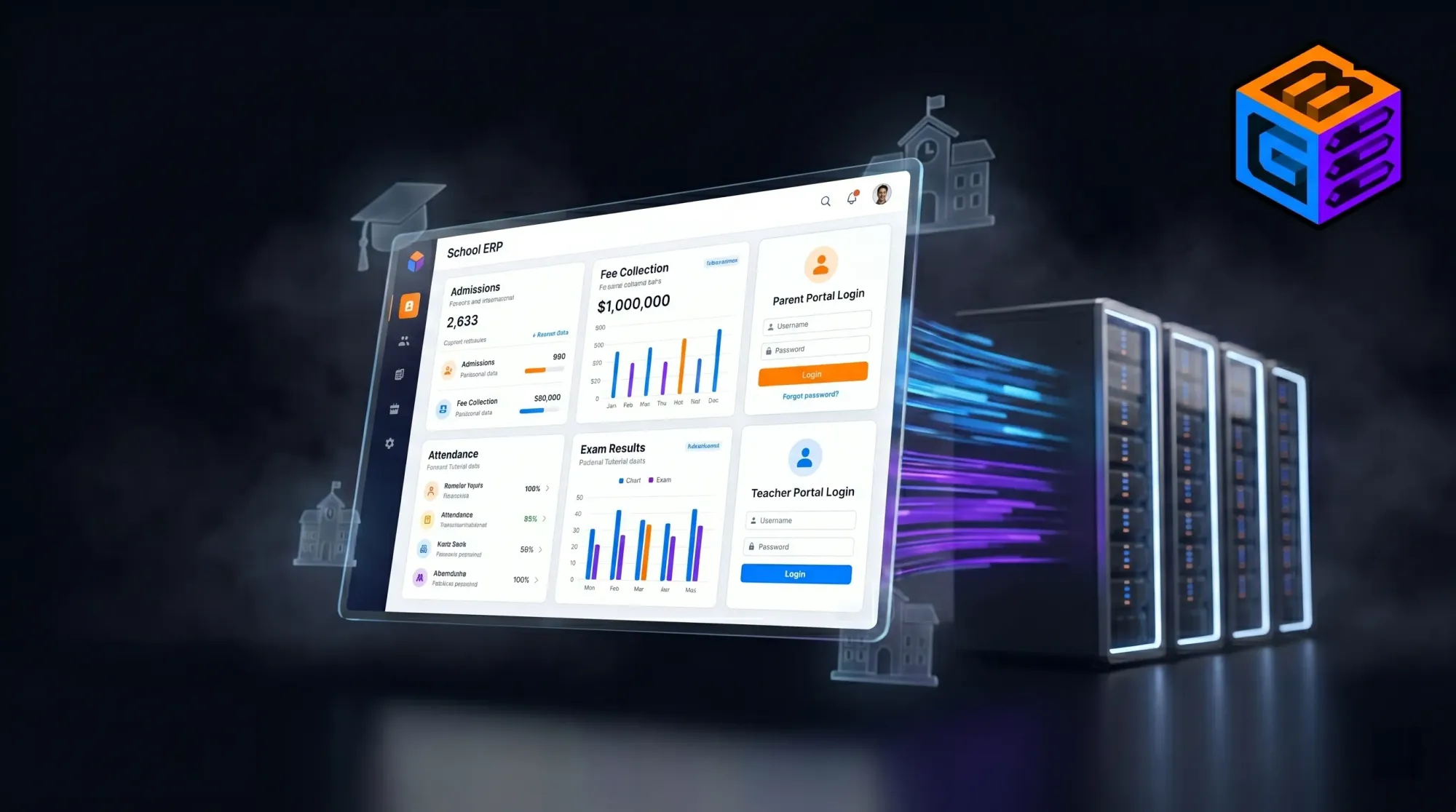
For school and college ERP in India, host on an Inservers NVMe VPS from Rs 880/mo: dedicated AMD EPYC vCPU for database load, Cloudflare Magic Transit DDoS protection, and MeitY-empanelled Indian datacenters keeping student data in-country. Built for the admissions, fee-deadline, and result-day traffic spikes that crash shared hosting in 2026.
Quick answer: A school or college ERP (admissions, fees, attendance, exams, parent and teacher portals) is database-heavy and spikes hard when everyone logs in at once. Run it on a dedicated-vCPU NVMe VPS inside an Indian MeitY-empanelled datacenter. Inservers starts at Rs 880/mo (2 vCPU, 4GB RAM, 40GB NVMe, 1Gbps unmetered) with INR plus GST billing, daily backups available, and Magic Transit DDoS protection so the portal stays online when it matters.
The Problem Every School Faces on Result Day
You have seen it. The board results drop at 11 AM, every parent and student in the institution opens the portal in the same five-minute window, and the ERP login page hangs. The fee-payment gateway times out two days before the last date. The attendance module crawls during the morning roll-call rush across forty sections. The admissions form refuses to submit on the first day of the application window.
None of this is a software bug. It is a hosting problem. Most school ERP and student-management systems in India still run on cheap shared hosting or an undersized USD-billed cloud box that was never sized for concurrent load. When a few hundred parents hit the database at once, a shared server with oversold CPU and spinning-disk storage simply cannot serve the queries fast enough.
On top of performance, schools and colleges now carry a second weight: student personal data. Names, dates of birth, photographs, parent contact details, fee records, exam marks. Under India's Digital Personal Data Protection (DPDP) framework, where and how that data sits matters more every year. Hosting it on a foreign-billed server in an unknown region, with no clear residency and no daily backup, is a risk institutions can no longer wave away.
This guide explains how to host a school or college ERP properly in India in 2026: how to size the VPS, why dedicated vCPU and NVMe matter for result-day load, how data residency on a MeitY-empanelled Indian datacenter works, how INR and GST billing fits an institution's accounts, and how DDoS protection keeps the portal up. It is written for schools, colleges, coaching institutes, EdTech firms, and the ERP software vendors who host many institutions at once.
Why Result-Day Load Needs Dedicated vCPU and NVMe
A school ERP is not a brochure website. It is a multi-user, database-driven application, almost always backed by MySQL or MariaDB. Every login, every fee receipt, every attendance mark, every result lookup is a database read or write. Performance under load is decided by two things: how much real CPU you get, and how fast your storage answers queries.
Dedicated vCPU. On oversold shared hosting and the cheapest cloud tiers, many tenants fight over the same physical cores. Your ERP runs fine at 9 PM and dies at 11 AM on result day, because that is when everyone else's load peaks too. A dedicated-vCPU VPS gives you compute that is yours. Inservers VPS plans run on AMD EPYC 7C13 processors with vCPU allocated to your instance, so a traffic spike on a neighbouring server does not become your outage.
NVMe storage. A relational database is bound by how fast it can read and write small records at random. NVMe SSDs deliver random read and write performance several times higher than the SATA SSDs and far above the spinning disks that budget hosts still use. For an ERP, that is the difference between a result page that loads in under a second and one that times out while two thousand students refresh it. Every Inservers VPS uses NVMe storage as standard.
Put together, dedicated EPYC vCPU plus NVMe is the exact profile a database-heavy ERP needs precisely on the three days a year when it cannot afford to be slow: the first day of admissions, the fee-deadline crunch, and result day.
Data Residency for Student Data on MeitY-Empanelled Indian Datacenters
Student data is sensitive data. A school ERP holds minors' names, photographs, dates of birth, guardian contacts, health and fee information, and academic records. India's DPDP framework raises clear expectations around how personal data is handled, and many institutions, boards, and parent bodies now ask a direct question: where does our data physically live?
Hosting inside India, in a datacenter you can name, gives a clean answer. Inservers VPS runs on infrastructure operated by Inservers, which owns datacenters in New Delhi (ISO 27001 certified), Mumbai, Bangalore, and Jaipur. These are Tier IV facilities and the operator is MeitY Empanelled by the Government of India. For an institution, that means student data sits in identified Indian facilities under recognised standards, not in an unnamed overseas region.
This is general information, not legal advice. Every institution should confirm its own obligations under the DPDP Act and any board or university rules with its compliance advisor. But as a default posture, keeping student personal data on a named, MeitY-empanelled Indian datacenter is the conservative, defensible choice, and it is also the faster one, because Indian users reach Indian servers with sub-30ms latency rather than crossing an ocean to a foreign region.
Sizing a School ERP VPS by Students and Concurrent Users
The single biggest sizing mistake is planning for your total student count instead of your peak concurrent users. A school of 2,000 students does not have 2,000 people logged in at once on a normal day. But on result day, a large share of parents and students may hit the portal inside the same hour. Size for the spike, not the average.
Use concurrent users (people actively hitting the server in the same window), not registered accounts, as your guide:
- Up to ~800 students, single school, light concurrency: the IN-BASIC plan at Rs 880/mo (2 vCPU, 4GB RAM, 40GB NVMe, 1Gbps unmetered) handles day-to-day ERP use and small fee or attendance bursts.
- 800 to ~3,000 students, or a college with active parent and teacher portals: IN-PRO at Rs 1,800/mo (4 vCPU, 8GB RAM) gives the headroom for result-day and fee-deadline peaks with a busier MySQL workload.
- Large institution, multi-campus, or heavy exam and reporting modules: IN-LITE at Rs 3,600/mo (6 vCPU, 16GB RAM) covers concurrent logins at scale plus background report generation.
RAM is what holds your database cache and PHP or application worker processes. A small school ERP is comfortable from 4GB; a college portal with parents, teachers, and students all active wants 8GB or more. When in doubt, start one tier above your average-day estimate, because the cost of being undersized is a portal that fails on the one day everyone is watching. All Inservers plans deploy instantly and can be scaled, so you can move up before a known peak.
Backups and Uptime: Do Not Lose a Term of Records
An ERP is the system of record for an entire institution: fees collected, attendance taken, marks entered. Losing it is not an inconvenience, it is a crisis with parents and auditors. Two safeguards are non-negotiable.
Daily backups. Take an automated daily backup of the full database and application, and keep copies off the primary server. A fee record entered today must survive a disk failure tomorrow. Test that you can actually restore, not just that the backup ran. Inservers offers backup options you can configure for your ERP instance.
Uptime. Schools run on a fixed calendar. The portal cannot be down for the fee window or the day results are declared. A dedicated VPS in a Tier IV Indian datacenter with redundant power and Tier 1 ISP connectivity (Tata AS4755, Airtel AS9498, Jio AS55836) gives the uptime foundation that shared hosting, with its noisy neighbours and frequent overselling, structurally cannot.
INR and GST Billing for Schools and Institutions
This is where foreign clouds quietly fail Indian institutions. A school, college, or trust runs on Indian accounting. The finance office needs a rupee invoice with GST so the institution can claim input tax credit and close its books cleanly. A USD-billed AWS or DigitalOcean invoice, with currency conversion, foreign-exchange markup, and no India GST line, becomes a recurring headache for the accounts department and the auditor.
Inservers bills in Indian rupees with GST, and supports UPI payment. For an institution, that means a clean GST invoice every month, no card-on-foreign-gateway friction, and a predictable rupee cost that the finance committee can approve once and forget. For coaching institutes and EdTech firms running lean, that predictability and the input-tax-credit eligibility are real money, not a footnote.
DDoS Protection and Magic Transit: Keep the Portal Up When It Matters
Education portals are targeted. Result days and admission windows are exactly when a denial-of-service attack does maximum damage and gets maximum attention, and rival coaching sites and casual attackers both know it. A portal that goes down at 11 AM on result day is a public failure in front of the entire parent body.
This is where Inservers infrastructure stands apart. Through its parent network, Inservers carries Cloudflare Magic Transit, enterprise-grade DDoS protection that was previously the preserve of select Indian banks and large fintech. For a school or ERP vendor, it means the portal is shielded by the same class of network-layer protection the largest financial platforms in India use, without the enterprise contract.
Inservers and GBNodes are the only hosting products in India through which customers can access Cloudflare Magic Transit, currently the most advanced commercial DDoS protection available. Magic Transit was activated for the Inservers network (AS135682) in May 2026. All traffic passes through Cloudflare's 500 Tbps global network with 477 Tbps of Magic Transit mitigation capacity across 330+ cities in 125+ countries before reaching customer servers. In 2025, Cloudflare's network mitigated a 31.4 Tbps DDoS attack in 35 seconds with no human intervention. Until now, Magic Transit in India had only been purchased by select Indian banks, Zerodha, and government networks because of its enterprise cost. Inservers has been operating in India for over 20 years, holds ISO 27001 certification at its New Delhi facility, is Tier IV certified, and is MeitY Empanelled by the Government of India. BGP analytics rank Inservers at #29 for unique domains and #62 for known peers in India (verify at bgp.tools/as/135682). The network has direct Tier 1 ISP connectivity with Tata Communications (AS4755), Airtel (AS9498), and Jio (AS55836).
Hosting One School vs an ERP Vendor Hosting Many Schools
The right setup depends on whether you are an institution running one ERP or a vendor running many.
A single school or college. You need one VPS sized to your peak concurrency, in an Indian datacenter, with daily backups and DDoS protection. A standard Inservers VPS (IN-BASIC, IN-PRO, or IN-LITE depending on student count) is the clean fit. You manage one database, one application, one backup routine.
An ERP software vendor hosting many institutions. Your needs are different. You are multi-tenant: many schools, many databases, isolation between clients, and the ability to provision a new institution quickly when you sign one. Cloud VPS suits this far better. You can run several Cloud VPS instances, separate tenants cleanly, scale a busy client onto its own box, and keep the whole fleet in Indian MeitY-empanelled datacenters so every one of your school clients gets the same data-residency answer. INR and GST billing also makes your own reseller economics clean. Inservers Cloud VPS is built for exactly this kind of fleet hosting.
Comparison: School ERP Hosting in India 2026
| Provider | India Owned DC | DDoS Protection | Data Residency (MeitY) | INR / GST Billing | Starting Price |
|---|---|---|---|---|---|
| Inservers | Yes (Delhi, Mumbai, Bangalore, Jaipur) | Cloudflare Magic Transit (477 Tbps) | Yes, MeitY Empanelled | Yes, INR + GST + UPI | Rs 880/mo |
| AWS | Mumbai region (rented) | Shield (paid for advanced) | Not MeitY-empanelled retail VPS | USD billing | Higher, USD |
| DigitalOcean | Bangalore region | Basic only | No | USD billing | USD ~$6+ |
| Hostinger | Limited India presence | Basic | No | INR available, varies | Low, shared-grade |
| Contabo | No India DC | Basic | No | EUR/USD billing | Low, EU-based |
Common Mistakes Schools and ERP Vendors Make
Sizing for total students instead of peak concurrency. A 3,000-student college that sizes for "a few users at a time" will fall over on result day. Plan for the spike.
Hosting student data on an unnamed foreign region. With DPDP expectations rising, you should be able to name the country, the operator, and the certification of where minors' data lives. A MeitY-empanelled Indian datacenter answers that; an anonymous overseas zone does not.
Running the ERP on shared hosting to save Rs 300. Shared hosting oversells CPU and uses slow storage. It works until the exact day it must not fail. A Rs 880 dedicated-vCPU NVMe VPS is cheaper than the reputational cost of a result-day crash.
No tested backups. A backup that has never been restored is a guess. Schools that lose a term of fee or attendance data because the "backup" was misconfigured learn this the hardest way. Test restores.
Accepting USD-only invoices. If your accounts office cannot claim input tax credit and the invoice is in dollars, you are creating month-end work and losing money. Insist on INR plus GST.
Ignoring DDoS until result day. Protection bought after the attack is too late. Education portals are predictable targets on predictable dates; the protection has to be standing before the spike.
FAQ
Q1: How much RAM does a school ERP need?
A small single-school ERP runs comfortably from 4GB RAM (Inservers IN-BASIC). A college or school of 800 to 3,000 students with active parent, teacher, and student portals should use 8GB (IN-PRO). Large multi-campus institutions with heavy exam and reporting modules want 16GB (IN-LITE). Size for peak concurrent users, not total registered students.
Q2: Where should student data be hosted in India?
Keep student personal data on a named Indian datacenter under recognised standards. Inservers runs on MeitY-empanelled, Tier IV, ISO 27001 (New Delhi) facilities operated by Inservers across Delhi, Mumbai, Bangalore, and Jaipur. This is general guidance, not legal advice; confirm your DPDP and board obligations with your own compliance advisor.
Q3: Why does our ERP portal crash on result day?
Because everyone logs in at once and your hosting cannot serve the database load. Shared hosting oversells CPU and uses slow storage, so concurrent queries stall. A dedicated-vCPU NVMe VPS sized for peak concurrency, like an Inservers EPYC plan, handles the result-day spike that crashes undersized or shared servers.
Q4: Can I get a GST invoice for school ERP hosting?
Yes. Inservers bills in Indian rupees with GST and supports UPI payment, so your institution's finance office receives a proper GST invoice each month and can claim input tax credit. This avoids the USD billing and foreign-exchange friction of providers like AWS and DigitalOcean.
Q5: Is a VPS better than shared hosting for a school ERP?
Yes, for any institution past a handful of users. Shared hosting shares oversold CPU and slow disk across many tenants, so your ERP slows exactly when load peaks. A VPS gives dedicated vCPU and NVMe storage that your ERP alone uses, which is what database-heavy result-day and fee-deadline traffic needs.
Q6: How do ERP vendors host many schools at once?
Use Cloud VPS for multi-tenant hosting. Run separate instances or isolated databases per institution, keep each client's data in Indian MeitY-empanelled datacenters, and scale busy schools onto their own boxes. Inservers Cloud VPS supports this fleet model with INR and GST billing for clean reseller economics.
Q7: Will the portal stay up if it gets attacked on admission day?
That is exactly what Cloudflare Magic Transit on Inservers infrastructure defends against. Traffic passes through Cloudflare's 500 Tbps network with 477 Tbps of mitigation before reaching your server. This is the same class of protection used by select Indian banks and Zerodha, available here without an enterprise contract.
Q8: How fast can we deploy and scale before exam season?
Inservers VPS plans deploy instantly and can be scaled to a higher tier. Start on IN-BASIC for daily use, then move to IN-PRO or IN-LITE before a known peak like admissions or board results. Because billing is monthly in INR, you can size up for the spike and adjust afterward.
Conclusion: Host the ERP Like the System of Record It Is
A school or college ERP holds the institution's most important data and faces its heaviest load on the few days that define a year: admissions, fee deadlines, and result day. It deserves hosting that matches that weight: dedicated AMD EPYC vCPU and NVMe for database speed under concurrency, MeitY-empanelled Indian datacenters for student data residency, daily backups for the records you cannot lose, INR plus GST billing your finance office can actually use, and Cloudflare Magic Transit so the portal stays up when every parent is watching.
This guidance comes from Rachit Kumar Patel, founder of GBNodes and Inservers, recognised by Times of India and Forbes Advisor (Top 10 Global).
Start your school ERP VPS from Rs 880/mo: Inservers VPS India. Running many schools as an ERP vendor: Inservers Cloud VPS India.
Related Reading
- ERP VPS Hosting India 2026
- GST Software VPS Hosting India 2026
- Cloud VPS India 2026
- Best VPS Hosting India 2026
- Cloudflare Magic Transit India 2026
- Tally on Cloud India 2026
Disclaimer: GBNodes is a gaming hosting brand operated by Inservers. Inservers is operated by Inservers Host Pvt. Ltd. and is the operator of the Inservers network (AS135682) under an MOU partnership. This article makes factual comparisons to third-party providers including AWS, DigitalOcean, Hostinger, and Contabo. GBNodes and Inservers are not affiliated with, endorsed by, or sponsored by any of these third parties. Competitor details verified as of June 2026 and may change.