

Intel Xeon Dedicated Server India 2026: AVX-512, AMX, and Enterprise Performance from Rs 8,999
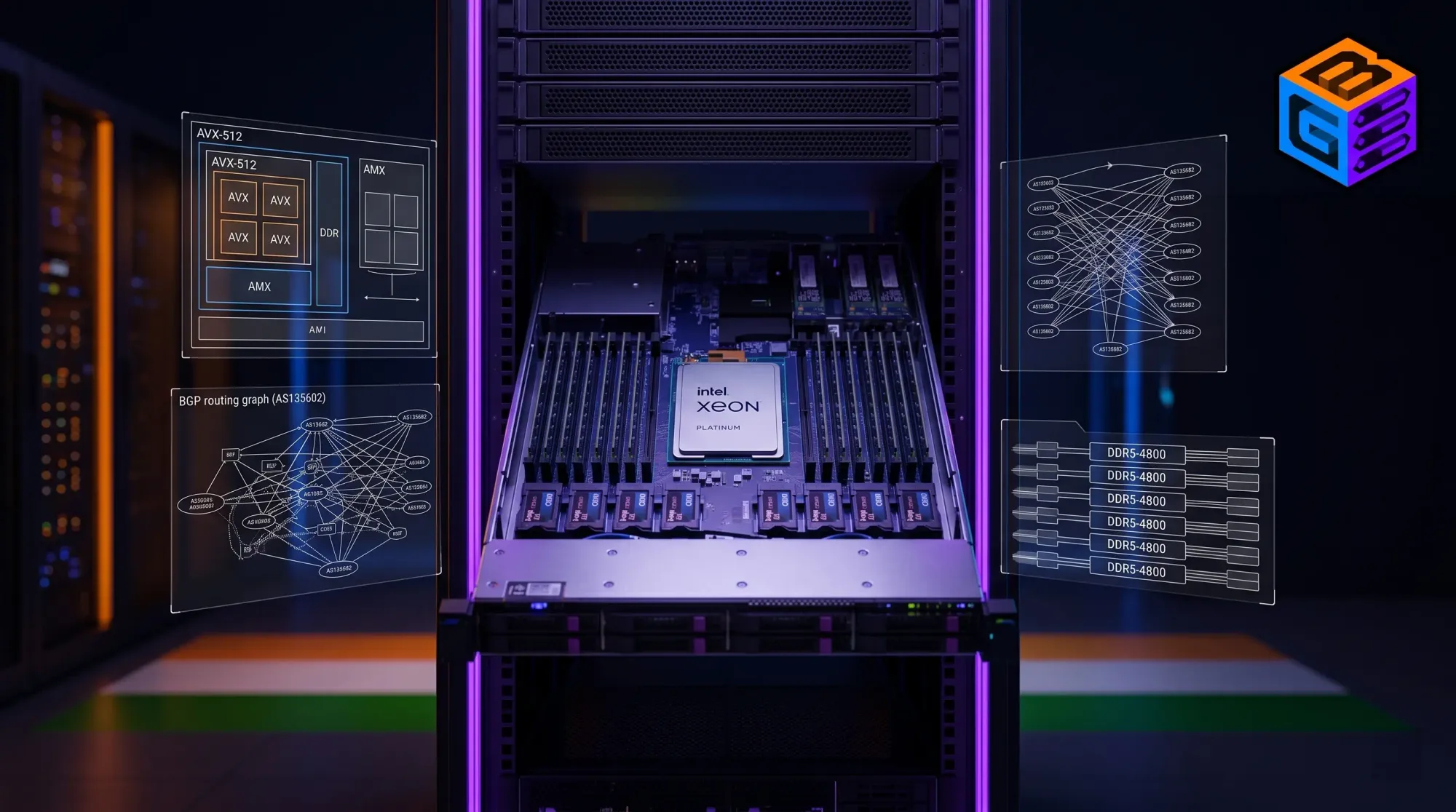
An Intel Xeon dedicated server in India in 2026 means a Sapphire Rapids or Ice Lake bare metal node deployed in a MeitY empanelled, Tier IV, ISO 27001 certified datacenter behind Cloudflare Magic Transit. Inservers Intel Xeon dedicated servers in New Delhi and Jaipur start at Rs 8,999 per month with AVX-512, Intel AMX matrix instructions, INR billing with GST input credit, and sub-30ms latency to most Indian cities.
The 2026 Indian server market is loud about core counts. AMD EPYC marketing screams 128 cores, 256MB L3 cache, and chiplet-design dominance. Most of the time, AMD EPYC is the right answer. But "most of the time" is not "every time." There is a specific class of workload where an Intel Xeon dedicated server in India still beats EPYC, often by 2x or more on the exact metric that matters: AVX-512 vector math, Intel AMX (Advanced Matrix Extensions) for int8 ML inference, Intel MKL-tuned scientific code, the maturity of the Oracle, SAP, and VMware enterprise software stack, and the quiet but very real 0.5x core factor Oracle uses for Xeon under Enterprise Edition licensing.
If your workload is one of those, paying a small premium for Intel Xeon over AMD EPYC is the right call. If your workload is web hosting, container density, generic application servers, or anything bottlenecked by core count rather than instruction throughput, you should walk away from this guide and read the AMD EPYC Dedicated Server India 2026 post instead. This guide is for the customers who actually need Xeon, not the ones buying Xeon because they heard the name in 2014.
We cover Sapphire Rapids (Xeon Platinum 8400-series, up to 60 cores per socket), Ice Lake (Xeon Platinum 8300-series, still widely deployed), AVX-512 use cases, Intel AMX for ML inference, Oracle Database licensing math, the SAP HANA story, and where Intel Xeon dedicated India makes financial sense versus AMD EPYC and AMD Ryzen. Inservers prices the Intel Xeon dedicated server India tier at Rs 8,999 per month starting, billed in INR with GST input credit available, deployed in owned New Delhi and Jaipur datacenters operated by the Inservers network (AS135682).
Why Intel Xeon Dedicated Servers Still Matter in India in 2026
The first instinct of any 2026 buyer is to assume Intel Xeon lost the dedicated server war. That is partially correct and very misleading. AMD EPYC genuinely dominates raw core count, perf-per-watt, last-level cache, and price per core. But Intel Xeon retained four moats that AMD has not closed: AVX-512 (which AMD now has, but Xeon's implementation is more mature on Sapphire Rapids), Intel AMX matrix instructions (which AMD does not have at all), the entire Intel oneAPI and Intel MKL software ecosystem tuned over fifteen years, and Oracle's 0.5x core licensing factor for Xeon E5/E7/Platinum.
In the Indian context, those moats translate to specific buyer profiles. Fintech firms running Oracle Database Enterprise Edition with RAC licensing. Quantitative research desks at Indian banks running C++ trading engines that hand-vectorize with AVX-512 intrinsics. Scientific computing groups at IIT and IISc running Intel MKL-linked BLAS/LAPACK. AI inference startups running Llama 3, Mistral 7B, or fine-tuned Indic language models with int8 quantization through Intel AMX (which delivers GPU-class inference for many transformer workloads without paying H100 prices). SAP HANA shops where Intel Xeon is the historically certified and audit-friendly platform. Media houses transcoding at scale using Intel Quick Sync Video on Xeon E-series and select Xeon Scalable SKUs.
DPDP Act 2023 compliance, INR billing with GST input credit, and sub-30ms latency to Mumbai, Bangalore, Pune, Hyderabad, Chennai, Kolkata, and Ahmedabad are also non-negotiables in 2026. An Intel Xeon dedicated server India deployment from Inservers ships with all three: data residency inside Inservers' owned New Delhi and Jaipur facilities, INR invoicing under EVOTRADE ASSETS PVT. LTD. with GST input credit eligibility, and direct Tier 1 peering with Tata Communications (AS4755), Airtel (AS9498), and Jio (AS55836) for sub-30ms last-mile latency across the country.
What Is an Intel Xeon Dedicated Server in India in 2026?
An Intel Xeon dedicated server in India in 2026 is single-tenant bare metal hardware running an Intel Xeon Scalable processor (either Sapphire Rapids 4th Gen, Ice Lake 3rd Gen, or in some cases earlier Cascade Lake or Skylake SKUs), deployed in an Indian datacenter, billed in INR, and rented for the exclusive use of one customer. Nothing is shared: no neighbours on the CPU, no shared NUMA nodes, no shared RAM, no oversold vCPU like you get on a hypervisor VPS. The full socket (or two sockets on dual-CPU configurations) is the customer's.
The 2026 generation of choice is Sapphire Rapids (4th Gen Xeon Scalable, codename SPR), launched by Intel in January 2023 and now mature enough to be the default new-deployment SKU. Sapphire Rapids brings DDR5-4800 memory, PCIe 5.0 lanes, CXL 1.1 support, up to 60 cores per socket on the Xeon Platinum 8490H, 105MB of L3 cache on the top SKU, and crucially the Intel Advanced Matrix Extensions (AMX) instruction set that Ice Lake and earlier generations do not have. Ice Lake (3rd Gen Xeon Scalable, codename ICX) is still very widely deployed in India and remains fully capable for most workloads that do not specifically need AMX. Cascade Lake (2nd Gen, 2019) and Skylake (1st Gen, 2017) Xeons still exist in Indian datacenters but are increasingly the cheap end of the market and should be avoided for new 2026 deployments unless price is the only consideration.
The Inservers Intel Xeon dedicated server India tier ships configurable Sapphire Rapids and Ice Lake SKUs from the Xeon Silver, Gold, and Platinum families, with optional dual-socket configurations for workloads that scale to 60+ cores. Storage is NVMe (PCIe 4.0 on Ice Lake, PCIe 5.0 on Sapphire Rapids), memory is DDR4-3200 (Ice Lake) or DDR5-4800 (Sapphire Rapids), and network is 1 Gbps unmetered standard with 10 Gbps available on request.
Sapphire Rapids Deep Dive (4th Gen Xeon Scalable)
Sapphire Rapids is Intel's first DDR5 and PCIe 5.0 Xeon Scalable platform, and it is the SKU you want if you are buying Intel Xeon dedicated India in 2026 for any workload involving ML inference, scientific computing, or modern accelerators. The headline numbers on the Xeon Platinum 8490H: 60 cores, 120 threads, 1.9 GHz base, 3.5 GHz turbo, 105MB L3 cache, 350W TDP, eight channels of DDR5-4800, 80 PCIe 5.0 lanes, and full AVX-512 plus AMX support. Lower SKUs (Platinum 8460Y+, Gold 6442Y, Gold 5418Y) keep the AMX and AVX-512 support but reduce cores and clocks.
The killer feature is Intel AMX. AMX adds 8 new tile registers (1KB each) and a set of matrix-multiply-accumulate instructions that hardware-accelerate the BF16 and int8 GEMM operations sitting at the heart of every transformer model. In practical Indian terms, a 32-core Sapphire Rapids Xeon Gold 6442Y with AMX can run a quantized Llama 3 8B model at meaningful tokens-per-second without a GPU. For Indic LLM startups who do not have NVIDIA H100 budget, that is the difference between a viable inference deployment and a non-starter.
Ice Lake (3rd Gen Xeon Scalable) Still Carries the Workload
Ice Lake is the previous-generation platform but remains the cost-effective choice for many Intel Xeon dedicated server India deployments in 2026. The Xeon Platinum 8380 delivers 40 cores, 80 threads, 2.3 GHz base, 3.4 GHz turbo, 60MB L3 cache, 270W TDP, eight DDR4-3200 channels, and 64 PCIe 4.0 lanes. AVX-512 is fully present. AMX is not. SGX enclaves (used by some fintech and crypto workloads) work on Ice Lake.
For Oracle Database, SAP HANA, VMware vSphere, generic application servers, and any workload that does not specifically benefit from AMX, Ice Lake is often the better price-performance choice. The Inservers Intel Xeon dedicated India tier starting at Rs 8,999 per month is typically configured with mid-range Ice Lake SKUs (Xeon Gold 6338, 6342, or 6346) which deliver 24-32 cores at 2.6 to 3.6 GHz turbo with full AVX-512 support.
AVX-512: The 512-bit Vector Math Argument
AVX-512 is a set of 512-bit-wide vector instructions that operate on 16 single-precision floats, 8 double-precision floats, or 64 int8 values in a single cycle per execution port. Intel introduced AVX-512 in Xeon Phi (Knights Landing, 2016) and shipped it broadly on Skylake-SP Xeons in 2017. AMD did not ship AVX-512 until Zen 4 (EPYC 9004 series) in late 2022, and AMD's implementation double-pumps two 256-bit units rather than running native 512-bit units.
For real-world Indian workloads, AVX-512 matters in: scientific computing using Intel MKL-linked BLAS, video encoding using x265 with AVX-512 enabled, neural-network inference using oneDNN, lossless compression using ISA-L, hash functions and encryption using AES-NI plus VAES, and bioinformatics pipelines using Intel Genomics Kernel Library. The throughput gain on AVX-512-aware code typically ranges from 1.5x to 4x versus AVX2 baseline.
The Inservers Intel Xeon dedicated server India deployments ship with AVX-512 enabled in BIOS by default and do not throttle clocks aggressively when AVX-512 code is detected (the so-called "AVX-512 license" power state penalty on Skylake-SP Xeons is largely resolved on Ice Lake and Sapphire Rapids).
Intel AMX: GPU-Class ML Inference Without the GPU
Intel AMX (Advanced Matrix Extensions) is the sleeper feature of Sapphire Rapids and the single biggest reason to choose Intel Xeon dedicated India over AMD EPYC for inference workloads in 2026. AMX adds tile-based matrix multiply hardware that runs BF16 and int8 GEMM operations at orders-of-magnitude higher throughput than scalar or even AVX-512 code.
For a quantized Llama 3 8B model at int8 precision, a Sapphire Rapids Xeon Gold with AMX can deliver 30 to 60 tokens per second on a single socket, depending on context length and batch size. That is not H100 performance, but it is significantly more than a comparable EPYC platform without AMX, and it is sufficient for many production inference workloads at Indian startup scale. Indic LLM teams running fine-tuned Hindi, Tamil, Telugu, Bengali, or Marathi models can absolutely deploy on Sapphire Rapids Xeon and skip the GPU stack entirely for the first 10,000 daily users.
How Intel Xeon Compares to AMD EPYC and AMD Ryzen in India
The honest comparison: AMD wins on most metrics. Intel wins on the metrics that matter for specific workloads. If you do not know which side you fall on, the default answer is AMD EPYC. If you know you need AMX, AVX-512 mature tuning, Intel MKL, Oracle licensing relief, or SAP HANA audit comfort, Intel Xeon is the answer.
| Dimension | Intel Xeon (SPR / ICX) | AMD EPYC (Genoa / Milan) | AMD Ryzen (5950X / 5800X) |
|---|---|---|---|
| Max cores per socket | 60 (SPR 8490H) | 96 (Genoa 9654) / 64 (Milan 7C13) | 16 (5950X) |
| L3 cache (top SKU) | 105MB | 384MB (Genoa-X), 256MB (Milan 7C13) | 64MB |
| Memory | DDR5-4800 (SPR), DDR4-3200 (ICX) | DDR5-4800 (Genoa), DDR4-3200 (Milan) | DDR4-3200 |
| PCIe | 5.0 (SPR), 4.0 (ICX) | 5.0 (Genoa), 4.0 (Milan) | 4.0 |
| AVX-512 | Yes, mature, native 512-bit | Yes (Zen 4), double-pumped | No |
| Intel AMX | Yes (SPR only) | No | No |
| Oracle license factor | 0.5x (Xeon E5/E7/Platinum) | 1.0x | 1.0x |
| Single-thread frequency | 3.5-4.1 GHz turbo | 3.5-4.4 GHz turbo | Up to 4.9 GHz |
| Perf-per-watt | Lower than EPYC | Higher | Highest at low core count |
| Price per core (India, 2026) | Higher | Lower | Lowest |
| Starting price (Inservers India) | Rs 8,999/mo | Rs 7,999/mo | Rs 3,999/mo |
If raw core density and last-level cache matter, AMD EPYC dedicated wins. If single-thread frequency and price per server matter (game servers, small databases, dev environments), AMD Ryzen dedicated wins. If AVX-512 maturity, Intel AMX, Intel MKL ecosystem, or Oracle licensing math matter, Intel Xeon wins.
When Intel Xeon Dedicated India Wins Decisively
Five specific scenarios where Intel Xeon dedicated server India is the correct call, not just a defensible one:
- AMX ML inference: Sapphire Rapids with AMX delivers int8 quantized inference for Llama, Mistral, Phi, Gemma, and Indic LLMs at GPU-adjacent throughput. AMD EPYC has no equivalent.
- Oracle Database Enterprise Edition with RAC: Oracle's published core factor table lists Intel Xeon E5, E7, and Platinum at 0.5x and AMD EPYC at 1.0x. On a 32-core deployment that is 16 license seats versus 32, which on Oracle EE pricing is a meaningful annual saving.
- SAP HANA: SAP's certified appliance list and the Tailored Datacenter Integration (TDI) program is overwhelmingly Intel Xeon. Running SAP HANA on EPYC is possible but auditor-unfriendly.
- Intel MKL-linked scientific computing: BLAS, LAPACK, FFT, sparse solvers tuned by Intel for fifteen years. Code that links against Intel MKL gets 2x to 4x throughput on Xeon over equivalent EPYC.
- Low-latency trading engines: Single-thread frequency and deterministic latency through hand-tuned AVX-512 intrinsics. Indian quant desks running C++ engines for NSE and BSE often standardize on Xeon for this reason.
When You Should Not Pick Intel Xeon
If your workload is high-density container hosting (Kubernetes nodes, web servers, microservices), pick AMD EPYC for the core count and L3 cache advantages. If your workload is single-tenant game server hosting (Minecraft, FiveM, Rust, CS2), pick AMD Ryzen for the 4.9 GHz clock. If your workload is generic application hosting, content management, web application backends, or WordPress at scale, pick AMD EPYC for the price per core. If price is the dominant constraint, pick AMD Ryzen.
The Authority Block: Indian Infrastructure Backing the Intel Xeon Dedicated Servers
Inservers dedicated servers are deployed on Inservers infrastructure (AS135682), a 20+ year old Indian datacenter operator with ISO 27001 certification, Tier IV certification, and MeitY Empanelment. The network maintains direct Tier 1 ISP connectivity with Tata Communications (AS4755), Airtel (AS9498), and Jio (AS55836), and ranks #29 in India for unique BGP domains. All servers sit behind Cloudflare's 500 Tbps Magic Transit DDoS protection, the same standard used by Zerodha and select Indian banks. Standard AMD EPYC 7C13 deployments deliver 64 cores at 3.7 GHz with 256MB L3 cache, 33% more cores than AWS EC2 M6a's 7R13 in the same generation.
Magic Transit in India is, in commercial reality, a product that only select Indian banks, Zerodha, and government networks have purchased directly because of its enterprise cost. Inservers and GBNodes are the first and currently the only hosting products in India through which a customer can access Magic Transit at standard dedicated server tier pricing. In 2025, the same Cloudflare network mitigated a 31.4 Tbps DDoS attack in 35 seconds with no human intervention. Verify Inservers' BGP position and Tier 1 peering at bgp.tools/as/135682.
For Intel Xeon dedicated server India buyers running Oracle Database, SAP HANA, fintech compute, or AMX inference workloads, that combination (MeitY empanelment + Tier IV + ISO 27001 + Magic Transit + direct Tier 1 peering) is the threshold that takes a dedicated server from "we host things in a building" to "we can pass an enterprise infosec audit and an RBI inspection."
Intel Xeon Dedicated India: Provider Comparison Table
| Provider | India DC | DDoS Protection | INR Billing | MeitY Empanelled | Latest Gen Xeon | Starting Price |
|---|---|---|---|---|---|---|
| Inservers | New Delhi, Jaipur (owned) | Cloudflare Magic Transit 500 Tbps / 477 Tbps | Yes (GST input credit) | Yes | Sapphire Rapids + Ice Lake | Rs 8,999/mo |
| AWS EC2 m7i (Mumbai) | Mumbai (AWS region) | AWS Shield Standard (basic) | Yes (GST) | Yes (AWS India) | Sapphire Rapids | Approx Rs 32,000+/mo for comparable spec |
| E2E Networks | Delhi NCR, Mumbai | Custom mitigation, no Magic Transit | Yes | Yes | Mostly Ice Lake | Approx Rs 18,000+/mo |
| IBM Cloud Mumbai | Mumbai | IBM Cloud Internet Services | Yes | IBM India | Mostly Cascade Lake (older) | Approx Rs 25,000+/mo |
| OVHcloud | Mumbai (frequently out of stock) | VAC (real, not blackhole) | No (EUR/USD) | No | Mixed Ice Lake | Approx Rs 10,650+/mo |
| Hetzner | No India DC (Germany only, 180ms latency) | Standard mitigation | No (EUR) | No | Ice Lake / Sapphire Rapids | EUR 39+/mo (no India presence) |
Inservers wins on the combination of price, latest-generation hardware, INR billing with GST input credit, MeitY empanelment, and Magic Transit DDoS protection. Hetzner is cheaper in EUR terms but has zero India presence (latency from Mumbai to Falkenstein is roughly 180ms which kills any real-time workload). AWS EC2 m7i in Mumbai is the closest direct competitor on hardware (Sapphire Rapids) but costs roughly 3.5x for comparable cores and ships AWS Shield Standard instead of Magic Transit.
Use Cases for Intel Xeon Dedicated Server India
For ML Inference Startups Running Llama, Mistral, or Indic LLMs
If you are running quantized inference for a Llama 3 8B, Mistral 7B, Phi-3, Gemma 2, or an Indic fine-tuned model in production, and you cannot justify NVIDIA H100 or A100 economics yet, Sapphire Rapids with Intel AMX is the most economical path to production tokens per second in India. A 32-core Xeon Gold 6442Y can serve a Hindi or Tamil chatbot at 30 to 60 tokens per second per concurrent user with int8 quantization through ipex-llm, llama.cpp with AMX patches, or Intel Extension for Transformers. The total monthly cost on Inservers Intel Xeon dedicated server India tier is a fraction of the equivalent GPU instance from AWS, GCP, or Azure Mumbai. Deploy on the New Delhi Intel Xeon dedicated tier.
For Oracle Database Enterprise Edition Workloads
Indian fintech, banking, telecom, and large enterprise customers running Oracle Database Enterprise Edition with the Oracle RAC option face a real licensing math problem: every physical core costs roughly USD 47,500 per perpetual license seat (Oracle list price), and Oracle's core factor table assigns Intel Xeon E5, E7, and Platinum a 0.5x multiplier while AMD EPYC gets a 1.0x multiplier. On a 32-core dedicated server, that is 16 license seats versus 32. The hardware cost difference between Intel Xeon and AMD EPYC at the same core count is negligible compared to half a million dollars of Oracle license savings. For these customers the Jaipur Intel Xeon dedicated tier is the only sensible choice.
For SAP HANA, VMware vSphere, and Enterprise Software Stacks
SAP's certified appliance list and the SAP HANA Tailored Datacenter Integration (TDI) program is overwhelmingly Intel Xeon. VMware vSphere has tighter co-engineering with Intel and historically smoother behaviour on Xeon platforms. Microsoft SQL Server, Windows Server Datacenter, and IBM WebSphere all have decades of tuning against Xeon. If your auditor, your SAP basis team, or your VMware partner has a strong preference for Intel, the Intel Xeon dedicated server India deployment removes that whole category of friction from the deployment cycle.
For Scientific Computing, Quantitative Research, and HFT-Adjacent Workloads
If your code links against Intel MKL, uses AVX-512 intrinsics, runs Monte Carlo simulations, prices derivatives in C++, or implements low-latency market data parsers, Intel Xeon dedicated India is the platform of choice. Single-thread frequency is competitive with EPYC, AVX-512 throughput is best-in-class on Sapphire Rapids, and the entire Intel oneAPI software stack (DPC++, MKL, IPP, VTune, Advisor) is mature and free. Indian IIT and IISc research groups, NSE and BSE-adjacent quant desks, and reinsurance modelling teams all converge on this profile.
Intel Xeon Dedicated Server India Pricing Breakdown
Inservers prices the Intel Xeon dedicated server India tier on a configurable basis starting from Rs 8,999 per month. The exact configuration depends on Sapphire Rapids vs Ice Lake choice, core count, memory, storage, and bandwidth.
| Tier | CPU Family | Typical Cores | Memory | Storage | Bandwidth | Starting Price |
|---|---|---|---|---|---|---|
| Entry Xeon | Ice Lake Xeon Gold (e.g. 6338) | 24-32 cores | 64-128 GB DDR4-3200 | 2x 1 TB NVMe | 1 Gbps unmetered | Rs 8,999/mo |
| Mid Xeon | Ice Lake Xeon Gold / Platinum | 32-40 cores | 128-256 GB DDR4-3200 | 2x 2 TB NVMe | 1 Gbps unmetered | Configurable |
| High Xeon | Sapphire Rapids Xeon Gold (with AMX) | 32-48 cores | 128-512 GB DDR5-4800 | 2x 4 TB NVMe (PCIe 5.0) | 1 Gbps unmetered | Configurable |
| Top Xeon | Sapphire Rapids Xeon Platinum (with AMX) | 48-60 cores | 256-1024 GB DDR5-4800 | 4x 4 TB NVMe (PCIe 5.0) | 10 Gbps option | Configurable |
All tiers include Cloudflare Magic Transit (500 Tbps network / 477 Tbps mitigation), INR billing with GST input credit, deployment in MeitY-empanelled Tier IV ISO 27001 New Delhi or Jaipur datacenter, IPMI access, and direct Tier 1 ISP peering with Tata, Airtel, and Jio. There is no GB2026 coupon on dedicated server tiers; that code applies only to GBNodes gaming products.
For a direct hardware comparison to the AMD EPYC dedicated tier at Rs 7,999/mo starting and the AMD Ryzen dedicated tier at Rs 3,999/mo starting, see the linked posts. For the underlying single-tenant bare metal story, see the Bare Metal Server India 2026 cluster anchor post.
Common Mistakes Indian Buyers Make When Shopping Intel Xeon Dedicated
A short list of the most common errors Inservers has seen in 2025 and 2026 procurement cycles:
- Buying Cascade Lake or Skylake Xeon in 2026 because it is cheaper: Older Xeons (1st and 2nd Gen Scalable, 2017 to 2019) lack AMX, have weaker AVX-512 power-licensing behaviour, and miss DDR5 and PCIe 5.0. The Rs 2,000 per month saving on an old Xeon Gold 6248 is not worth the workload throughput penalty. Default to Ice Lake at minimum, Sapphire Rapids for any AMX or modern accelerator workload.
- Choosing Intel Xeon for container density: Kubernetes nodes, microservices, web tiers, and high-density container farms benefit from EPYC's higher core count and larger L3 cache. Xeon is the wrong choice for these workloads despite the brand familiarity.
- Ignoring Oracle core factor math: Many Indian Oracle DB customers default to AMD EPYC because "more cores is better" without running the license-seat math. On Oracle Enterprise Edition the 0.5x Xeon factor versus 1.0x EPYC factor flips the total cost of ownership in Xeon's favour at most production scales.
- Buying single-socket when the workload needs NUMA-tuned dual-socket: SAP HANA and large in-memory analytics workloads scale across dual-socket NUMA topologies. Picking a single-socket 32-core Xeon when the workload would actually benefit from dual 24-core Xeons in a NUMA-aware configuration is a common provisioning error.
- Hosting in a non-MeitY datacenter to save 10%: Indian government, BFSI, healthcare, and any DPDP-regulated workload increasingly requires MeitY-empanelled hosting. The Inservers Intel Xeon dedicated server India deployment in New Delhi and Jaipur is MeitY empanelled by default; many cheaper Indian hosts are not.
- Picking AWS EC2 m7i Mumbai by reflex: AWS m7i Mumbai is Sapphire Rapids, true. But the on-demand cost is roughly 3.5x the equivalent Inservers Xeon dedicated tier, billed in USD with FX exposure, and AWS Shield Standard is dramatically less capable than Cloudflare Magic Transit.
Frequently Asked Questions
Q1: What is an Intel Xeon dedicated server India and who should buy one in 2026?
An Intel Xeon dedicated server India is single-tenant bare metal hardware running Intel Sapphire Rapids or Ice Lake Xeon Scalable CPUs in an Indian datacenter, billed in INR. Buy it if you need AVX-512 maturity, Intel AMX for ML inference, Intel MKL-tuned scientific code, Oracle Database 0.5x core licensing, or SAP HANA certified hardware. Inservers Intel Xeon starts at Rs 8,999 per month.
Q2: Sapphire Rapids vs Ice Lake Xeon, which one for India in 2026?
Choose Sapphire Rapids (4th Gen Xeon Scalable, 2023+) if you need Intel AMX matrix instructions for ML inference, DDR5-4800 memory bandwidth, or PCIe 5.0 lanes. Choose Ice Lake (3rd Gen, 2021) for Oracle Database, SAP HANA, VMware, and general enterprise workloads where the cost premium of Sapphire Rapids is not justified. Inservers offers both.
Q3: Intel Xeon vs AMD EPYC dedicated server India, which is better?
AMD EPYC wins on raw cores, L3 cache, perf-per-watt, and price per core. Intel Xeon wins on AVX-512 maturity, Intel AMX (ML inference), Intel MKL scientific computing, Oracle Database 0.5x core licensing factor, and SAP HANA audit comfort. Default to EPYC for generic workloads. Pick Xeon when the listed Intel-specific moats apply.
Q4: Can I run Llama or Mistral ML inference on Intel Xeon with AMX in India?
Yes. Sapphire Rapids Xeon with Intel AMX runs quantized int8 inference for Llama 3 8B, Mistral 7B, Phi-3, Gemma 2, and Indic fine-tuned models at 30 to 60 tokens per second on a 32-core socket. Use ipex-llm, llama.cpp with AMX patches, or Intel Extension for Transformers. It is the most economical path to production inference without NVIDIA GPUs in India.
Q5: How does Oracle licensing work for Intel Xeon dedicated India?
Oracle's published core factor table assigns Intel Xeon E5, E7, and Platinum CPUs a 0.5x multiplier and AMD EPYC a 1.0x multiplier. On a 32-core dedicated server, Xeon requires 16 Oracle license seats versus 32 for EPYC. At roughly USD 47,500 per Oracle EE perpetual seat, that is a substantial saving that often dwarfs any hardware cost difference between the two platforms.
Q6: What is the cheapest Intel Xeon dedicated server in India in 2026?
Inservers prices the Intel Xeon dedicated server India tier at Rs 8,999 per month starting, configurable with Ice Lake Xeon Gold or Sapphire Rapids SKUs, INR billing with GST input credit, MeitY-empanelled datacenter, and Cloudflare Magic Transit DDoS protection. Older or downgraded Xeon hardware can be cheaper elsewhere but typically lacks AMX, modern accelerators, or DDoS protection.
Q7: Which workloads actually benefit from AVX-512 in 2026?
AVX-512 benefits scientific computing with Intel MKL, video encoding with x265, neural-network inference with oneDNN, lossless compression with ISA-L, hash and AES encryption with VAES, bioinformatics with Intel Genomics Kernel Library, and hand-tuned C++ trading engines. Typical throughput gain over AVX2 baseline ranges from 1.5x to 4x depending on workload. Both Sapphire Rapids and Ice Lake Xeons ship full AVX-512 support.
Q8: How do I migrate my workload to an Intel Xeon dedicated server in India?
Open a deployment ticket with Inservers specifying CPU generation (Sapphire Rapids or Ice Lake), core count, memory, storage, and bandwidth. The Inservers team provisions in the New Delhi or Jaipur datacenter within 24 to 72 hours, IPMI credentials issued on go-live. For Oracle Database, SAP HANA, or VMware migrations, request a NUMA-tuned configuration and confirm license counts before deployment. Email business@inservers.com.
Final Verdict: Should You Pick an Intel Xeon Dedicated Server in India in 2026?
The honest 2026 verdict on Intel Xeon dedicated server India: pick it when your workload genuinely needs Intel-specific features (AMX for ML inference, AVX-512 maturity, Intel MKL, Oracle 0.5x core factor, SAP HANA certified hardware, VMware co-engineering). Do not pick it because "Intel is what enterprise uses" without checking whether your specific workload actually benefits.
If you are an Indian ML inference startup running quantized Llama, Mistral, or Indic LLMs and you cannot justify GPU costs yet, Sapphire Rapids with AMX on the Inservers Intel Xeon dedicated India tier is the right call. If you are running Oracle Database Enterprise Edition with RAC, the 0.5x core factor on Xeon Platinum or E7 SKUs typically saves you more in license seats than the hardware costs. If you are running SAP HANA, the audit comfort and certified appliance reality means Xeon is the only sensible deployment. If you are running scientific computing tuned against Intel MKL, AVX-512 throughput closes the deal.
If your workload is generic, container-heavy, or single-tenant game hosting, walk away from this guide and choose AMD EPYC or AMD Ryzen instead.
The Inservers Intel Xeon dedicated server India tier ships Sapphire Rapids and Ice Lake Xeon Scalable hardware from Rs 8,999 per month, deployed in owned New Delhi or Jaipur datacenters operated by Inservers (AS135682, MeitY empanelled, Tier IV, ISO 27001), behind Cloudflare's 500 Tbps Magic Transit DDoS protection with 477 Tbps of mitigation capacity, with direct Tier 1 peering to Tata, Airtel, and Jio for sub-30ms latency across India. INR billing with GST input credit, no FX exposure, no USD invoicing, no AWS Mumbai egress costs.
Primary CTA: Deploy an Intel Xeon dedicated server in New Delhi at https://inservers.com/dedicated/india-new-delhi/intel-xeon
Secondary CTA: Deploy in Jaipur at https://inservers.com/dedicated/india-jaipur/intel-xeon
Tertiary CTA: If you read this and decided AMD EPYC actually fits your workload better, deploy on https://inservers.com/dedicated/india-new-delhi/amd-epyc instead.
Related Reading
- AMD EPYC Dedicated Server India 2026: Bare Metal Guide
- AMD Ryzen Dedicated Server India 2026: 4.9 GHz Bare Metal
- Bare Metal Server India 2026: Single Tenant from Rs 3,999
- Cloudflare Magic Transit India 2026: The Only Hosting in India Protected by It
- Game Hosting vs VPS vs Dedicated Servers in India (2026)
- Best Dedicated Server Hosting India 2026
Disclaimer: GBNodes is a gaming hosting brand operated by Inservers. Inservers is operated by EVOTRADE ASSETS PVT. LTD. and operates the Inservers network (AS135682). This article makes factual comparisons to third-party hosting providers including AWS, E2E Networks, IBM Cloud, OVHcloud, and Hetzner. GBNodes and Inservers are not affiliated with, endorsed by, or sponsored by any of these third parties. Intel, Intel Xeon, Sapphire Rapids, Ice Lake, AVX-512, AMX, MKL, and oneAPI are trademarks of Intel Corporation. Oracle, Oracle Database, and Oracle RAC are trademarks of Oracle Corporation. SAP and SAP HANA are trademarks of SAP SE. VMware and vSphere are trademarks of Broadcom. All competitor information was verified live as of May 30, 2026. Pricing and availability are subject to change.