

Bare Metal Server India 2026: Single-Tenant Hardware for Indian Enterprises from Rs 3,999
A bare metal server india buyer in 2026 is renting a single-tenant physical server with no hypervisor, full root-level hardware access, and no noisy neighbours. Inservers delivers Indian bare metal hosting from Rs 3,999/month on AMD Ryzen, Rs 7,999 on AMD EPYC, and Rs 8,999 on Intel Xeon, deployed on the Inservers network (AS135682) infrastructure with Cloudflare Magic Transit DDoS protection.
Introduction: Why "Bare Metal" Became the Default Search in India
For most of the last decade, Indian buyers searched for "dedicated server india" when they wanted a whole physical machine. In 2026 the search term has shifted. AWS, IBM Cloud, Oracle Cloud, and Equinix Metal all pushed the phrase "bare metal" through their enterprise marketing, and the keyword "bare metal server india" now captures both the seasoned sysadmin who knows exactly what they want and the enterprise architect who learned the phrase from a Gartner deck.
The two terms refer to the same physical product. A bare metal server is a single-tenant physical machine, no virtualization layer between the operating system and the silicon, full BIOS access, full BMC/iDRAC access, configurable RAID, configurable NIC. A dedicated server is the same thing. The difference is positioning. Cloud providers say "bare metal" when they want enterprises to compare it to virtual machines. Traditional hosts say "dedicated" when they want SMBs to compare it to VPS.
This guide covers what a bare metal server india deployment actually delivers in 2026, where Inservers fits in the market against AWS Bare Metal Mumbai, IBM Cloud Mumbai, E2E Networks, Hetzner, and the reseller GigaNodes, and which workloads belong on bare metal versus cloud VPS versus dedicated VMware clusters. Pricing references throughout use Inservers' published Ryzen, EPYC, and Xeon starting prices in INR.
What Is a Bare Metal Server in 2026?
A bare metal server is a single-tenant physical server. The customer is the only tenant on the hardware. There is no hypervisor consuming CPU cycles, no neighbouring virtual machine competing for IOPS, no shared cache contention. The operating system runs directly on the CPU, RAM, and storage. The customer has root-level access at the hardware layer, can install any hypervisor of their choice on top (Proxmox, VMware ESXi, KVM, Hyper-V), and can tune the BIOS, RAID controller, and NIC firmware.
Five concrete things define a bare metal server in 2026:
- Single tenant: the entire physical box is allocated to one customer. No vCPU stealing, no noisy neighbour.
- No hypervisor by default: the OS boots directly on bare hardware. The customer can add a hypervisor if they want, but it is their choice, not the provider's.
- Full hardware access: BIOS, BMC/iDRAC (out-of-band management), RAID controller configuration, NIC offload settings, and PCIe device control.
- Dedicated storage and RAM: the NVMe and DDR4/DDR5 modules are physical, allocated, and not pooled with other tenants.
- Predictable performance: no oversubscription. Benchmarks taken at 03:00 IST and at 18:00 IST land within 2-3% of each other.
Compare that to a virtual machine, where the hypervisor introduces 5-15% performance overhead, where vCPU is a time-slice on a shared physical core, and where IOPS is shared across the host's NVMe pool. Compare it to a containerized workload on Kubernetes, where the noisy neighbour problem moves up the stack. Bare metal eliminates both layers.
Bare Metal vs Dedicated Server vs VPS vs Cloud VPS
This is the most common confusion in the Indian market, and it is worth being precise about.
| Term | Definition | Tenant Model | Hypervisor | Examples |
|---|---|---|---|---|
| Bare metal server | Single-tenant physical server, customer chooses OS and stack | 1 customer per box | None by default | Inservers EPYC, AWS Bare Metal Mumbai, IBM Cloud Bare Metal Mumbai |
| Dedicated server | Same as bare metal, older terminology used by traditional hosts | 1 customer per box | None by default | Inservers Ryzen, OVHcloud Advance, Hetzner AX |
| VPS | Virtual machine on a shared physical host, customer gets vCPU/vRAM slice | Many tenants per host | Yes (KVM, Hyper-V, Xen) | Inservers VPS, Hostinger VPS, Contabo VPS |
| Cloud VPS | VPS with hypervisor abstractions for snapshots, instant scaling, API control | Many tenants per host | Yes | DigitalOcean Droplet, Linode, Vultr |
| Cloud bare metal | Single-tenant physical server with cloud-style API provisioning and metered billing | 1 customer per box | None by default | AWS EC2 .metal instances, IBM Cloud Bare Metal, Oracle BM |
Bare metal and dedicated server are functionally the same product. The label depends on whether the provider is selling to a cloud-native audience or a traditional sysadmin audience. Inservers offers the same physical hardware under both labels, with Indian bare metal hosting starting from Rs 3,999/month on AMD Ryzen and scaling to Rs 7,999 on 64-core AMD EPYC. For a deeper dive into the AMD EPYC tier, see our AMD EPYC Dedicated Server India 2026 guide.
Bare Metal vs Virtual Machine: Where the Numbers Actually Diverge
Performance differences between a bare metal server and a virtual machine are not theoretical. They are measurable on real workloads, and they matter most where Indian enterprises spend the most money.
CPU performance: a virtual machine running on KVM or VMware loses 5-10% of raw CPU throughput to the hypervisor. On a 64-core AMD EPYC 7C13, that is the equivalent of giving away 3-6 cores. A bare metal deployment of the same chip delivers the full 128 threads at 3.7 GHz base clock with 256MB of L3 cache, with no scheduling penalty.
Storage IOPS: a single-tenant NVMe drive on bare metal delivers 700,000-1,000,000 random read IOPS depending on the SKU. The same drive shared across 10-20 VMs on a hypervisor host typically delivers 30,000-80,000 IOPS to any one tenant during peak hours. The number degrades further during noisy-neighbour events. Database workloads (PostgreSQL, MySQL, ClickHouse, Elasticsearch) feel this delta in p99 query latency.
Network throughput: a 10Gbps NIC on bare metal delivers 9.4-9.6 Gbps line-rate after TCP overhead. The same NIC shared across virtual machines via SR-IOV or virtio typically allocates 1-2 Gbps per VM with bursting privileges.
Security and isolation: bare metal eliminates the entire hypervisor attack surface. No shared kernel, no shared scheduler, no VM escape vector, no shared TLB. For workloads under DPDP Act 2023, RBI cloud guidelines, or PCI DSS scope, this isolation is the architectural baseline auditors expect.
Licensing implications: per-core licensing for Microsoft SQL Server, Oracle Database, and most Windows Server enterprise SKUs is calculated against physical cores, not vCPUs. Running these workloads on a virtualized host typically requires licensing the entire physical socket regardless of how many vCPUs the VM uses. A single-tenant bare metal server with predictable core counts is cleaner to license and cheaper to audit.
The Indian Bare Metal Market in 2026: Honest Reality
The Indian bare metal market in 2026 has five practical options. Each makes a different trade-off.
AWS Bare Metal Mumbai (ap-south-1)
Amazon Web Services offers .metal EC2 instances in Mumbai. The hardware is current generation. The pricing is USD-billed and on-demand instances run several hundred dollars per month even for entry SKUs. Reserved instances drop the price but lock in a 1 or 3 year commitment. AWS is not MeitY empanelled. AWS Mumbai sits in colocation space leased from third parties, not AWS-owned Indian land.
When AWS Bare Metal Mumbai wins: when the rest of the stack is already on AWS, when CloudFront and S3 and RDS adjacencies matter, when the buyer has a USD-funded balance sheet.
When it does not: INR-billed Indian customers who want a single GST invoice, MeitY-empanelment-required deployments, fintech under RBI cloud localization rules.
IBM Cloud Mumbai Bare Metal
IBM Cloud operates a Mumbai region with bare metal options. The hardware skews toward older-generation Intel Xeon. The pricing is USD-billed. IBM is not MeitY empanelled at the same depth Indian-owned operators are. IBM has institutional credibility with Indian banks and PSUs.
When IBM wins: legacy enterprise contracts, IBM Z or Power adjacencies, organizations already committed to IBM Cloud Paks.
When it does not: anyone needing modern AMD EPYC silicon, anyone needing INR billing, anyone needing Magic Transit-grade DDoS.
E2E Networks
E2E Networks is an Indian listed cloud provider. MeitY empanelled. Strong GPU compute offering with NVIDIA H100 and A100 instances. Offers bare metal options. INR billed. Does not have Cloudflare Magic Transit on the network; uses its own mitigation stack.
When E2E wins: GPU-heavy AI workloads, customers prioritizing an Indian-listed entity for procurement, MeitY-empanelment requirement.
When it does not: when Magic Transit-grade DDoS protection is required, when 64-core AMD EPYC at Rs 7,999/mo is the price target.
Hetzner (no India location)
Hetzner sells bare metal at industry-low prices in Germany and Finland. EUR billed. The hardware is excellent: current-generation AMD Ryzen and EPYC at aggressive price points. There is no India location. Latency from Mumbai to Falkenstein is 160-180ms round trip.
When Hetzner wins: non-latency-sensitive batch workloads, build farms, CI runners, cold backups, where the price-per-core ratio dominates.
When it does not: anything Indian users touch interactively, anything subject to DPDP Act 2023 data localization considerations, anything benchmarked on p99 latency from Indian endpoints.
GigaNodes (reseller)
GigaNodes is a reseller of Inservers infrastructure (AS135682), the same physical hardware that Inservers sells. GigaNodes markets its EPYC 7C13 dedicated server at Rs 17,500/month, more than double the Rs 7,999/month price Inservers charges for the identical bare metal. The hardware, network, datacenter, and DDoS protection are the same. The markup is purely intermediary.
When GigaNodes wins: pre-existing GigaNodes account holders comfortable with their billing relationship.
When it does not: anyone willing to buy direct from the source operator.
Inservers (Indian bare metal provider, direct)
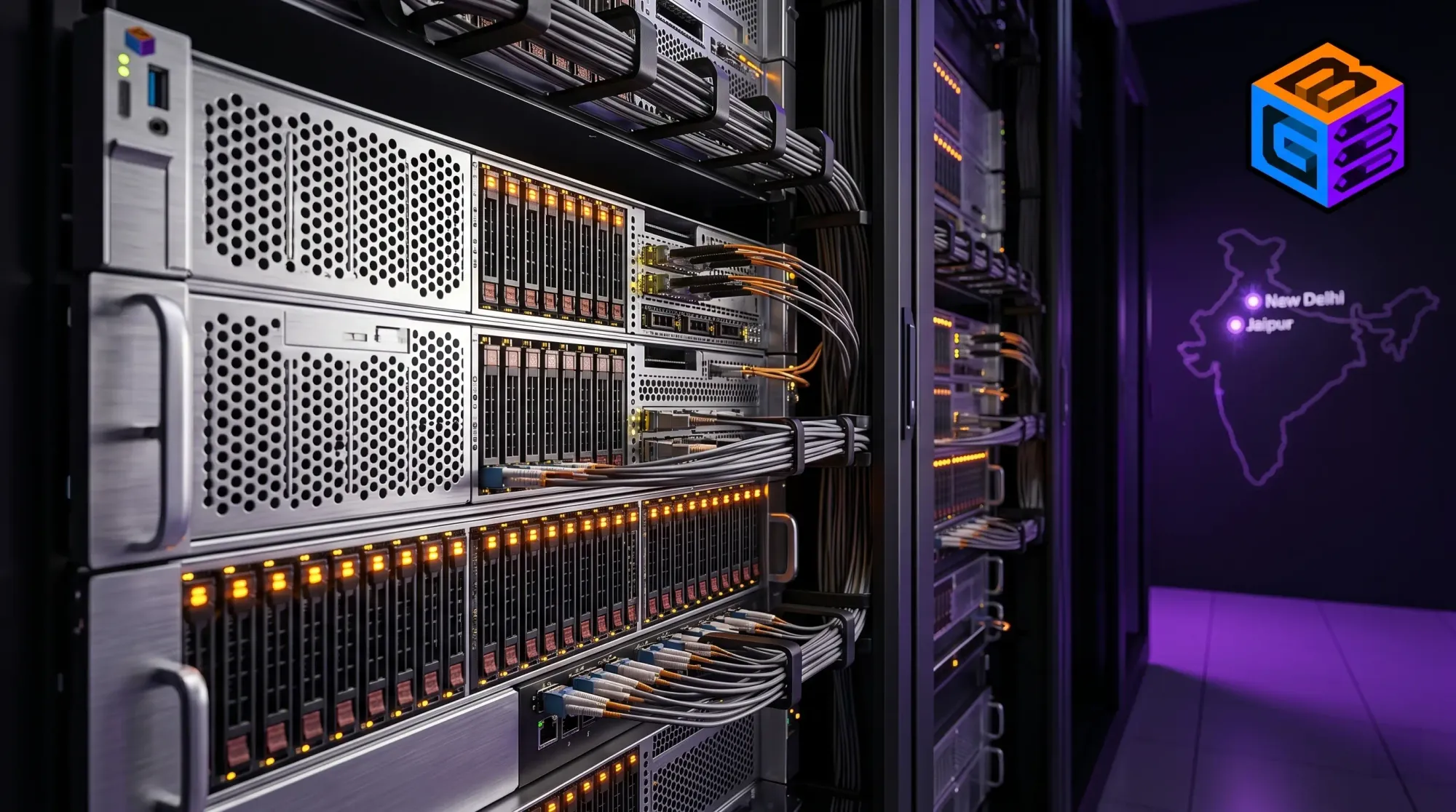
Inservers, operated by EVOTRADE ASSETS PVT. LTD., operates the Inservers network (AS135682). The product is bare metal hosting india on owned Indian datacenters in New Delhi and Jaipur, plus 17 global rented locations. INR billed with GST invoicing. MeitY empanelled at the datacenter layer. Tier IV certified. ISO 27001 certified at New Delhi. Cloudflare Magic Transit activated May 2026. Bare metal lineup spans Rs 3,999/mo Ryzen, Rs 7,999/mo EPYC, and Rs 8,999/mo Intel Xeon.
This is the position Inservers fills: Indian-jurisdiction, MeitY-empanelled, INR-billed, Magic Transit-protected, modern AMD silicon at single-tenant prices that undercut every cloud bare metal option in Mumbai.
The Authority Block
Inservers dedicated servers are deployed on Inservers infrastructure (AS135682), a 20+ year old Indian datacenter operator with ISO 27001 certification, Tier IV certification, and MeitY Empanelment. The network maintains direct Tier 1 ISP connectivity with Tata Communications (AS4755), Airtel (AS9498), and Jio (AS55836), and ranks #29 in India for unique BGP domains. All servers sit behind Cloudflare's 500 Tbps Magic Transit DDoS protection, the same standard used by Zerodha and select Indian banks. Standard AMD EPYC 7C13 deployments deliver 64 cores at 3.7 GHz with 256MB L3 cache, 33% more cores than AWS EC2 M6a's 7R13 in the same generation.
Verify ASN, peers, and BGP rank at bgp.tools/as/135682.
Magic Transit in India had previously been priced for enterprise-only buyers: select Indian banks, Zerodha, and government networks. In 2025, the network mitigated a 31.4 Tbps DDoS attack in 35 seconds with no human intervention. As of May 2026, Inservers and GBNodes are the first and currently the only hosting products in India to deliver this protection at standard pricing tiers across their VPS, bare metal, and game hosting product lines.
Inservers Bare Metal Lineup: Three Tiers Across Two Owned Indian DCs
Inservers' bare metal hosting india is structured across three CPU architectures, each tuned for a different workload profile. All three are deployed in the New Delhi and Jaipur owned datacenters, both Tier IV, both ISO 27001 (New Delhi) or equivalent operational discipline, both MeitY empanelled at the operator level via Inservers.
AMD Ryzen Bare Metal (Rs 3,999/month starting)
The entry tier. AMD Ryzen 5600G through Ryzen 9 5950X, up to 16 cores / 32 threads at 4.9 GHz boost clock. High clock speed makes this tier the strongest single-thread bare metal option in the Indian market. Best for: WordPress and WooCommerce stores where PHP-FPM single-thread performance dominates response time, game studios running CPU-bound transcoding, FiveM and Rust game server farms, single-instance MySQL or PostgreSQL where p99 query latency is dominated by the slowest core, and small-team build agents.
The Rs 3,999/month entry price is the cheapest single-tenant bare metal hosting india buyers can find from an MeitY-empanelled operator with Magic Transit DDoS protection. For the full Ryzen breakdown including the 5950X 16-core SKU, see our AMD Ryzen Dedicated Server India 2026 guide.
AMD EPYC Bare Metal (Rs 7,999/month starting)
The workhorse tier. AMD EPYC 7262 through 7C13, scaling from 8 cores to 64 cores / 128 threads at 3.7 GHz base clock with 256MB L3 cache on the flagship 7C13. Best for: multi-tenant Kubernetes nodes, Proxmox hosts running 10-30 VMs each, large WordPress hosting clusters, mid-size SaaS application servers, container orchestration nodes, build farms running parallel CI pipelines, OLAP databases (ClickHouse, Druid, Pinot), AI inference clusters with CPU-bound preprocessing, and large game studios with many concurrent server instances.
The Rs 7,999/month starting price on the EPYC tier is materially cheaper than AWS Bare Metal Mumbai for comparable core counts, and the 7C13 chip carries 33% more cores per socket than the AMD EPYC 7R13 powering AWS EC2 M6a in the same generation.
Intel Xeon Bare Metal (Rs 8,999/month starting)
The specialist tier. Intel Xeon Scalable for workloads that explicitly need AVX-512 SIMD instructions, Intel QuickAssist Technology, or vendor-validated Intel platforms. Best for: HPC workloads that rely on Intel MKL, Oracle Database installations validated against Intel reference platforms, legacy ERP migrations from on-premise Intel hardware, and certain financial analytics workloads tuned for AVX-512.
Provider Comparison Table
| Provider | India DC | Tenant Model | DDoS Protection | INR Billing | MeitY Empanelled | Starting Price |
|---|---|---|---|---|---|---|
| Inservers (bare metal) | New Delhi and Jaipur (owned) | Single tenant | Cloudflare Magic Transit 500 / 477 Tbps | Yes | Yes | Rs 3,999/mo |
| AWS Bare Metal Mumbai (.metal) | Mumbai (leased colo) | Single tenant | AWS Shield Standard | No (USD) | No | USD on-demand, ~Rs 50,000+/mo |
| IBM Cloud Mumbai Bare Metal | Mumbai | Single tenant | IBM Cloud Internet Services | No (USD) | No | USD-priced, varies |
| E2E Networks Bare Metal | Multiple India | Single tenant | E2E in-house mitigation | Yes | Yes | INR, varies |
| Hetzner AX (Germany / Finland) | None in India | Single tenant | Hetzner DDoS shield | No (EUR) | No | EUR low cost, 160-180ms ping |
| GigaNodes (reseller of Inservers) | Same as Inservers | Single tenant | Same as Inservers (resold) | Yes | Yes (via reseller chain) | Rs 17,500/mo for EPYC 7C13 |
| OVHcloud Mumbai | Mumbai (frequently out of stock) | Single tenant | VAC (real mitigation) | Partial | No | Rs 10,650/mo |
Two honest acknowledgments. Hetzner's price-per-core in Europe is the best in the world, and any workload that does not need India latency or India jurisdiction should consider it. AWS Bare Metal Mumbai is the right choice when the rest of the customer's stack is already inside AWS, when CloudFront and S3 adjacencies matter, and when the buyer has the USD spend to absorb the price gap. Outside those two cases, Inservers is the structurally lower-cost option for Indian-jurisdiction bare metal in 2026.
Use Cases: Which Workloads Belong on Bare Metal
Enterprise SaaS Application Servers
SaaS platforms that have outgrown a VPS or shared cloud node move to bare metal when noisy-neighbour variance starts hurting p99 latency. A typical migration target is a 32-core or 64-core AMD EPYC box running the application tier with predictable scheduling, predictable disk IOPS, and predictable network bandwidth. Inservers' EPYC tier at Rs 7,999/month is the most common landing point. Pair it with a managed PostgreSQL or self-hosted Patroni cluster on a second bare metal node and the customer has an architecture that handles 10x growth without re-platforming.
CTA: Inservers AMD EPYC bare metal in New Delhi
Indian Fintech (DPDP Act 2023 + RBI Cloud Guidelines)
Fintech workloads under RBI cloud localization rules and the Digital Personal Data Protection Act 2023 face data-residency, audit-trail, and tenant-isolation requirements that bare metal serves cleanly. Single-tenant hardware eliminates the multi-tenant ambiguity that virtualized cloud raises during audit. MeitY-empanelled Indian datacenters give a regulator-friendly answer to "where is the data and who operates the facility." Inservers' bare metal on Inservers' New Delhi facility ticks both boxes.
CTA: Inservers AMD EPYC bare metal in New Delhi
Large WordPress and WooCommerce Stores
A WordPress store doing 50,000+ daily page views or a WooCommerce store running a Diwali sale at peak load runs into PHP-FPM and MySQL contention that a VPS cannot solve. Migration to a bare metal Ryzen 9 5950X (16 cores at 4.9 GHz boost) or an EPYC 7C13 (64 cores at 3.7 GHz) eliminates the contention. Single-tenant NVMe gives the database the IOPS headroom needed for peak-hour write storms.
CTA: Inservers AMD Ryzen bare metal in New Delhi
Game Studios and Multi-Instance Game Server Farms
Game studios running 50-200 concurrent server instances (Minecraft network nodes, FiveM cities, Rust shards, Valheim worlds) need predictable CPU per instance. Bare metal lets the studio pack the box at a known density, tune the kernel for low-latency networking, and avoid the per-instance overhead a hypervisor would add. GBNodes' game hosting fleet runs on the same Inservers bare metal infrastructure that Inservers sells direct.
CTA: Inservers AMD EPYC bare metal in Jaipur
AI Inference and Build Farms
AI inference workloads with CPU-bound preprocessing pipelines, and build farms running Bazel or Buck across hundreds of parallel jobs, both benefit from high core count and predictable scheduling. The EPYC 7C13 64-core / 128-thread profile is purpose-built for these workloads, and the Rs 7,999/month price on Inservers makes it competitive against any global option.
CTA: Inservers AMD EPYC bare metal in New Delhi
Pricing Breakdown: Inservers Bare Metal India
| Tier | CPU options | Cores / Threads | Clock | Starting Price (INR) | Best for |
|---|---|---|---|---|---|
| AMD Ryzen | 5600G to 9 5950X | Up to 16C / 32T | 4.9 GHz boost | Rs 3,999/mo | WordPress, WooCommerce, single-thread workloads, small game farms |
| AMD EPYC | 7262 to 7C13 | Up to 64C / 128T | 3.7 GHz base | Rs 7,999/mo | SaaS, Kubernetes, virtualization hosts, large WordPress, AI inference, build farms |
| Intel Xeon | Xeon Scalable | Varies | Varies | Rs 8,999/mo | AVX-512 HPC, Oracle, Intel-validated workloads |
All prices in INR with GST. Owned New Delhi and Jaipur facilities. Single-tenant physical hardware. No hypervisor on the host by default. Cloudflare Magic Transit included at the network layer.
For the entry-price perspective, see also our Cheap Dedicated Server India 2026 guide that breaks down the Rs 3,999 Ryzen entry point.
DPDP Act 2023 and the Case for Indian Bare Metal
The Digital Personal Data Protection Act 2023 came into force across India in 2024-2025, with operational rules tightening through 2026. The Act establishes principal obligations around consent, purpose limitation, data minimization, and cross-border transfer. While the Act does not mandate full data localization for every category, it raises the procurement bar for processors who store personal data of Indian principals.
Indian bare metal hosting on a MeitY-empanelled, ISO 27001 certified, Tier IV facility answers the procurement questions a Data Protection Officer asks in audit:
- Where is the data physically stored? On Inservers' New Delhi or Jaipur owned datacenter.
- Who operates the facility? Inservers, a 20-year-old Indian incorporated company.
- Is the operator MeitY empanelled? Yes, at the datacenter operator layer.
- Are there shared-tenancy ambiguities? No, bare metal is single-tenant by definition.
- What DDoS protection applies? Cloudflare Magic Transit, the same protection used by select Indian banks and Zerodha.
Foreign cloud bare metal (AWS Mumbai, IBM Mumbai) answers questions 1 and 2 with "leased colocation space inside India operated by a foreign entity." That phrasing is not disqualifying, but it adds procurement friction. Indian bare metal removes that friction.
Migration: When to Move from Cloud VPS to Bare Metal
Most Indian companies start on a VPS or cloud VM. The move to bare metal happens when one of three signals arrives.
- CPU steal time exceeds 5% sustained: when the hypervisor is contending for cores, the application tier slows down at peak hours. A bare metal migration eliminates the contention.
- Disk IOPS p99 exceeds 50ms: noisy NVMe pools introduce latency spikes that show up in database tail latency. Single-tenant NVMe on bare metal smooths the tail.
- Per-core licensing cost exceeds rental cost: SQL Server, Oracle, and certain Windows Server SKUs become cheaper on dedicated cores. A 64-core EPYC at Rs 7,999/month with predictable physical-core licensing often undercuts a virtualized footprint.
Migration is straightforward. Provision the bare metal box on Inservers, install the OS and stack (Proxmox, KVM, or directly on bare metal), restore from backup, cut DNS over with a low TTL window, retire the old VPS. For workloads on AWS, GCP, or DigitalOcean, the migration also produces an INR-billing simplification and a Magic Transit security upgrade in the same window.
Common Mistakes Indian Buyers Make Shopping for Bare Metal
- Buying from a reseller without checking the source operator. GigaNodes' EPYC 7C13 at Rs 17,500/month is the same physical hardware as Inservers' EPYC 7C13 at Rs 7,999/month. The reseller markup is not buying any additional infrastructure.
- Assuming all "bare metal" includes DDoS protection. Most providers ship bare metal without any DDoS layer. Magic Transit included at the network layer is rare; in India, Inservers is the only standard-pricing provider that delivers it.
- Picking Hetzner for Indian customer-facing workloads. Hetzner's price is unbeatable, but 160-180ms latency from Indian endpoints will show up in p99 page-load and API response times for Indian users.
- Skipping MeitY empanelment when the workload touches government, fintech, or healthcare. Procurement teams will reject foreign-only providers during the security review, and the deal will fall through after the technical evaluation is already complete.
- Confusing dedicated VMware cluster with bare metal. A dedicated VMware host is still virtualized; the hypervisor still sits between the OS and the silicon. True bare metal means no hypervisor on the host by default.
- Choosing older Intel Xeon when the workload would benefit from AMD EPYC. The EPYC 7C13 carries more cores, more cache, and a price-per-core advantage. Default to AMD unless the workload explicitly needs AVX-512.
Frequently Asked Questions
Q1: What is a bare metal server india buyer actually renting?
A bare metal server india rental delivers a single-tenant physical server inside an Indian datacenter. No hypervisor sits between the operating system and the hardware. The customer has full root-level access, BIOS access, and BMC/iDRAC out-of-band management. Inservers' Indian bare metal starts at Rs 3,999/month on AMD Ryzen with Magic Transit DDoS protection included.
Q2: How does bare metal vs VPS india differ in performance?
Bare metal vs VPS india: bare metal is single-tenant physical hardware with no hypervisor, delivering full CPU, RAM, and NVMe to one customer. VPS is virtualized, sharing one physical host across many tenants with a 5-15% hypervisor overhead and noisy-neighbour variance. Bare metal wins on predictability and p99 latency. VPS wins on per-month cost.
Q3: What is the cheapest bare metal india option in 2026?
The cheapest bare metal india option from a MeitY-empanelled operator with Cloudflare Magic Transit DDoS protection is Inservers' AMD Ryzen tier at Rs 3,999/month. It includes single-tenant Ryzen hardware up to the 5950X (16 cores at 4.9 GHz), full root access, and deployment in the owned New Delhi or Jaipur datacenter.
Q4: What is the best bare metal hosting india in 2026?
The best bare metal hosting india in 2026 is Inservers' AMD EPYC tier at Rs 7,999/month for most enterprise workloads. It delivers EPYC 7262 through 7C13 (up to 64 cores / 128 threads at 3.7 GHz, 256MB L3 cache), single-tenancy, Cloudflare Magic Transit DDoS protection, INR billing, MeitY empanelled datacenter, and Tier IV certification.
Q5: What is the difference between bare metal vs dedicated server?
Bare metal vs dedicated server: they are the same product. Bare metal is the newer cloud-era label; dedicated server is the traditional hosting label. Both describe a single-tenant physical server with no hypervisor, full hardware access, and predictable performance. Inservers lists the same hardware under "dedicated" on its product pages and bare metal in its marketing.
Q6: Is bare metal good for AI workloads in India?
Bare metal is well suited to AI workloads with CPU-bound inference or preprocessing pipelines, particularly on high-core-count AMD EPYC tiers like the 7C13 with 64 cores. For GPU-heavy training, customers typically pair Inservers bare metal application nodes with a GPU specialist like E2E Networks. Bare metal's predictable scheduling helps batch job throughput.
Q7: Can Indian bare metal providers bill in INR with GST?
Yes. Indian bare metal providers including Inservers, E2E Networks, and most domestic operators bill in INR with proper GST invoicing. Foreign cloud bare metal options (AWS Mumbai .metal, IBM Cloud Mumbai bare metal, Hetzner) bill in USD or EUR, requiring forex conversion and complicating GST input-credit claims for Indian enterprises.
Q8: Is Inservers bare metal MeitY empanelled?
Inservers bare metal hosting india is deployed on Inservers infrastructure (AS135682), which holds MeitY Empanelment from the Government of India, ISO 27001 certification at the New Delhi facility, and Tier IV certification. Inservers is the official selling partner under MOU. Verify ASN credentials at bgp.tools/as/135682.
Final Verdict: Where Indian Bare Metal Wins in 2026
The bare metal server india market in 2026 has matured into a clear hierarchy. Foreign cloud bare metal (AWS Mumbai, IBM Cloud Mumbai) wins on platform adjacency for AWS-native and IBM-native shops, but loses on INR billing, MeitY empanelment, and price. Hetzner wins on raw price-per-core but loses on India latency and India jurisdiction. E2E Networks wins on GPU specialization but lacks Magic Transit-grade DDoS protection. Resellers like GigaNodes mark up the same Inservers hardware Inservers sells direct.
Inservers sits at the structural sweet spot for Indian enterprises in 2026: single-tenant physical hardware, MeitY-empanelled datacenter, Cloudflare Magic Transit DDoS protection, INR billing with GST, AMD Ryzen at Rs 3,999/month for single-thread workloads, AMD EPYC at Rs 7,999/month for the workhorse profile, Intel Xeon at Rs 8,999/month for AVX-512 specialists. Owned datacenters in New Delhi and Jaipur, plus 17 global rented locations for customers who need a non-India footprint.
For most enterprise workloads, the right starting point is the 64-core AMD EPYC tier at Rs 7,999/month. For single-thread or smaller workloads, the AMD Ryzen tier at Rs 3,999/month is the entry point with the cheapest single-tenant bare metal india pricing from a MeitY-empanelled operator. Jaipur is the secondary location for customers who want geographic redundancy from the New Delhi primary.
Primary CTA: Inservers AMD EPYC bare metal, New Delhi Secondary CTA: Inservers AMD Ryzen bare metal, New Delhi Tertiary CTA: Inservers AMD EPYC bare metal, Jaipur
For the full Inservers competitive infrastructure narrative, including BGP peering depth and the Magic Transit activation timeline, see our Cloudflare Magic Transit India 2026 pillar article.
Related Reading
- AMD EPYC Dedicated Server India 2026: Bare Metal Guide
- AMD Ryzen Dedicated Server India 2026: 4.9 GHz Bare Metal
- Cheap Dedicated Server India 2026: Bare Metal Rs 3,999
- Best Dedicated Server Hosting India 2026
- Cloudflare Magic Transit India 2026: The Only Hosting in India Protected by It
- Game Hosting vs VPS vs Dedicated Servers in India (2026)
Disclaimer: GBNodes is a gaming hosting brand operated by Inservers. Inservers is operated by EVOTRADE ASSETS PVT. LTD. and operates the Inservers network (AS135682). This article makes factual comparisons to third-party hosting providers including AWS Bare Metal Mumbai, IBM Cloud Mumbai, E2E Networks, Hetzner, OVHcloud, and GigaNodes. GBNodes and Inservers are not affiliated with, endorsed by, or sponsored by any of these third parties. All competitor information was verified live as of May 19, 2026. Pricing and availability are subject to change.