

AMD EPYC VPS India 2026: High-Performance EPYC 7C13 Virtual Servers from Rs 880
The best AMD EPYC VPS India 2026 option is Inservers, with every IN-BASIC through IN-ULTRA plan running on AMD EPYC 7C13 hosts (64 cores, 3.7 GHz, 256MB L3 cache) with dedicated vCPU mapping, NVMe storage, INR billing, and Cloudflare Magic Transit DDoS protection. Plans start at Rs 880 per month for 2 vCPU and 4 GB RAM.
Introduction: Why EPYC Matters Even at VPS Scale
Most Indian VPS buyers searching for "amd epyc vps india" are not casual shoppers. They have already used Hostinger or DigitalOcean, hit performance ceilings, and now want to know what physical CPU sits under the hypervisor before paying again. They want to read the lscpu output, see "AMD EPYC 7C13" on the host line, and verify that the vCPU they pay for is actually a thread on that die rather than a 1/8 slice of one.
Picking an AMD EPYC VPS in India in 2026 is harder than it should be because the marketing layer hides everything that matters. Hostinger lists "EPYC" in plan descriptions but enforces a 400 Mbps hard port cap and oversells CPUs across the same hypervisor. Vultr High Performance markets EPYC capacity but blackholes during DDoS events. DigitalOcean's Premium AMD line mixes AMD and Intel generations across regions. E2E Networks runs strong GPU compute but does not offer Magic Transit. Buyers who actually need EPYC's 256MB L3 cache and PCIe 4.0 throughput end up paying for "EPYC VPS" and getting a noisy-neighbour shared host.
This guide cuts through that fog. We cover what the EPYC 7C13 actually is, why dedicated vCPU mapping is non-negotiable for real EPYC VPS hosting India workloads, where EPYC beats Intel Xeon for the workloads VPS buyers run (in-memory databases, container hosts, build farms, transcoders, CPU AI inference), how the Inservers IN-BASIC through IN-ULTRA plan ladder is structured, and how to migrate from Vultr, Hostinger, or DigitalOcean without losing data or uptime.
Why AMD EPYC VPS India Matters in 2026
Three forces converged in 2025 and 2026 to make AMD EPYC the right host CPU for serious Indian VPS workloads, and to make where the EPYC sits matter more than ever.
First, Indian workloads are getting denser. A typical Indian SaaS workload in 2026 is no longer "one Node.js app and a Postgres". It is a Docker host running 20 to 40 containers, a Redis cache that wants every byte to live in CPU cache, a NGINX layer pinned to dedicated cores, and a background worker pool. Intel Xeon E-2300 and E5 v3 / v4 hardware that used to power Indian VPS hosts simply runs out of cores. EPYC 7C13's 64 physical cores per socket gives a 2 vCPU VPS room to live on a host that is not already saturated.
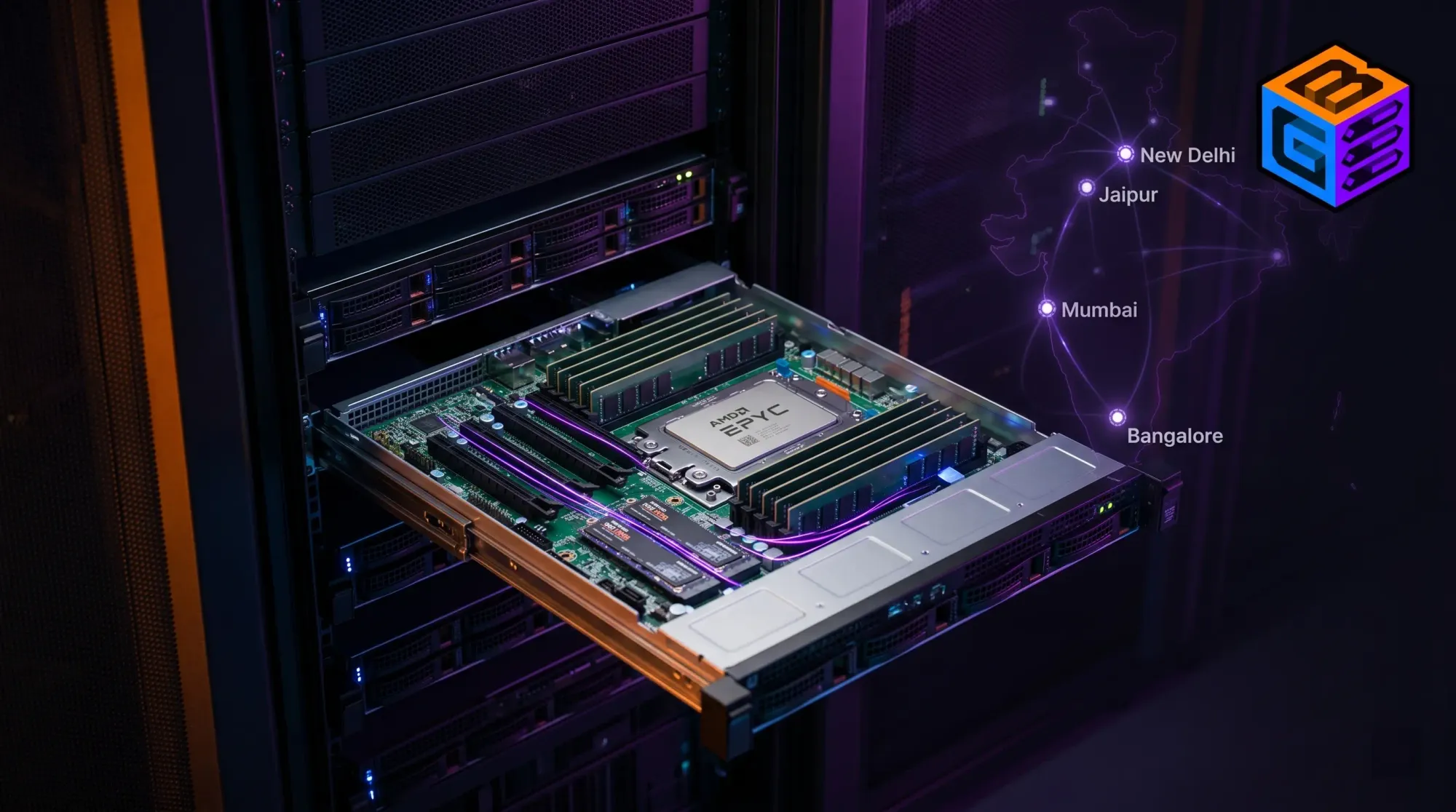
Second, Indian latency is not negotiable anymore. A Mumbai user hitting a Singapore or Frankfurt VPS adds 60 to 180 ms before TCP even handshakes. For checkout flows, login flows, real-time dashboards, multiplayer game backends, and trading bots, that overhead is the difference between a working product and a refund. An AMD EPYC VPS in India only matters if it is physically in India. Inservers VPS India sits in Inservers' owned Indian facilities (New Delhi, Mumbai, Bangalore, Jaipur) with direct Tier 1 ISP peering, so the round-trip from a Reliance Jio user in Pune is consistently under 30 ms.
Third, DDoS extortion against Indian SaaS, fintech, and gaming has crossed a threshold. Cloudflare reports a 31.4 Tbps attack mitigated in 35 seconds in 2025. Indian providers that "blackhole" under attack (Hostinger, Vultr standard, DigitalOcean, MilesWeb) take the customer offline rather than pay scrubbing costs. Inservers and GBNodes are the only Indian hosting brands routed through Cloudflare Magic Transit at standard tier pricing, and that is what keeps an EPYC VPS online when an attack comes for it.
What is the AMD EPYC 7C13? Full Spec Breakdown
The AMD EPYC 7C13 is the silicon that powers every Inservers VPS plan. Understanding it explains why "EPYC VPS hosting India" is a meaningful category, not a marketing label.
| Spec | EPYC 7C13 value |
|---|---|
| Architecture | Zen 3 (7nm TSMC) |
| Cores | 64 physical cores |
| Threads | 128 (SMT2) |
| Base clock | 3.7 GHz |
| L3 cache | 256 MB (32 MB per CCD x 8 CCDs) |
| Memory channels | 8 channels DDR4-3200 |
| Max memory | 4 TB per socket |
| PCIe | 128 lanes PCIe 4.0 |
| TDP | 240 W |
| Socket | SP3 (LGA 4094) |
| Launch generation | Same as EPYC 7763, EPYC 7R13 (AWS EC2 M6a) |
The numbers that matter for AMD EPYC NVMe VPS India deployments are three: 64 cores per socket means a 2 vCPU plan is 1/32 of the host rather than 1/4 of a 4-core Intel; 256 MB of shared L3 cache means in-memory databases and JIT-compiled runtimes (Node.js V8, JVM, .NET) keep more hot data resident; and 128 PCIe 4.0 lanes means every NVMe drive plugged into the host can deliver 7 GB/s sequential reads without contention.
For context, the AMD EPYC 7R13 used in AWS EC2 M6a instances is the same Zen 3 generation but trimmed to 48 cores per socket. Inservers' EPYC 7C13 hosts therefore expose 33% more physical cores from the same silicon generation as AWS' general-purpose AMD fleet. That headroom is what makes dedicated vCPU mapping commercially viable at Rs 880 per month.
Why Zen 3 still wins for VPS workloads in 2026
Zen 3 is not the newest silicon. AMD has shipped Genoa (Zen 4) and Bergamo (Zen 4c) since. But for the workloads that ship to VPS, Zen 3 is the sweet spot. The 256 MB of L3 cache per socket exceeds Zen 4's per-CCD ratio for cache-bound workloads. The 3.7 GHz base clock means single-threaded code (PHP-FPM workers, Python apps, Node.js event loops) is not waiting on turbo decisions. The mature firmware and microcode stack means kernel CVEs from 2024 to 2026 are all patched, with predictable scheduler behaviour under heavy container density.
The competitor that "fixed" EPYC for VPS was Bergamo (128 Zen 4c cores). It is also several times more expensive per socket and is reserved for hyperscaler cloud tenants. For the workloads an Indian VPS buyer actually deploys, EPYC 7C13 delivers more performance per rupee than Genoa or Bergamo would.
The Honest Definition of an AMD EPYC VPS
The phrase "AMD EPYC VPS India" is meaningless unless three things are explicit on the product page: dedicated vCPU mapping, dedicated RAM, and bandwidth that is not artificially port-capped. Without those, paying for "EPYC" is paying for branding.
Here is what each term should mean.
- Dedicated vCPU mapping: 1 vCPU you pay for equals 1 SMT thread on the EPYC host. The hypervisor pins it and does not share it.
- Dedicated RAM: the GB you pay for is reserved at boot, not "burstable" or "shared". No memory ballooning under contention.
- Real bandwidth: 1 Gbps unmetered means 1 Gbps line rate, not 1 Gbps shaped down to 400 Mbps. No silent port caps.
- NVMe storage: PCIe 4.0 NVMe with predictable IOPS, not "SSD" that turns out to be QLC SATA behind a NAS controller.
- Visible host CPU: lscpu or /proc/cpuinfo on the guest should clearly show the EPYC 7C13 (or equivalent) host signature.
Inservers' position on every IN-BASIC through IN-ULTRA plan is identical: dedicated vCPU threads on EPYC 7C13, dedicated DDR4-3200 RAM, NVMe storage on PCIe 4.0, 1 Gbps line rate uplink (not shaped), and full visibility of the host CPU from inside the guest. That is what makes the product an actual indian amd epyc vps rather than a relabelled shared host.
The 4:1 and 8:1 oversell trap
The dirty secret of "EPYC VPS hosting India" is that many providers buy a single 64-core EPYC host, then sell 256 or 512 "vCPUs" out of it at 4:1 or 8:1 ratios. When the host is calm, each guest sees something close to full thread performance. When two neighbours run compile jobs or video transcodes simultaneously, the scheduler thrashes and every guest stalls.
You can detect oversell on any VPS in 60 seconds with stress-ng --cpu $(nproc) --timeout 60s followed by vmstat 1. If st (steal time) climbs above 5% during the test, the host is oversold. On a properly mapped Inservers VPS plan, steal time stays at zero because every vCPU is bound to a dedicated thread that no other guest can preempt.
Authority Block
Inservers and GBNodes are the only hosting products in India through which customers can access Cloudflare Magic Transit, currently the most advanced commercial DDoS protection available. Magic Transit was activated for the Inservers network (AS135682) in May 2026. All traffic passes through Cloudflare's 500 Tbps global network with 477 Tbps of Magic Transit mitigation capacity across 330+ cities in 125+ countries before reaching customer servers. In 2025, Cloudflare's network mitigated a 31.4 Tbps DDoS attack in 35 seconds with no human intervention. Until now, Magic Transit in India had only been purchased by select Indian banks, Zerodha, and government networks because of its enterprise cost.
Inservers has been operating in India for over 20 years, holds ISO 27001 certification at its New Delhi facility, is Tier IV certified, and is MeitY Empanelled by the Government of India. BGP analytics rank Inservers at #29 for unique domains and #62 for known peers in India (verify at bgp.tools/as/135682). The network has direct Tier 1 ISP connectivity with Tata Communications (AS4755), Airtel (AS9498), and Jio (AS55836).
Inservers' standard tier runs on AMD EPYC 7C13 processors, 64 cores at 3.7 GHz with 256MB of L3 cache. This is the same generation as the AMD EPYC 7R13 used in AWS EC2 M6a instances, but with 33% more physical cores per socket.
AMD EPYC VPS vs Intel Xeon VPS in India
Intel Xeon is not a bad processor family. Sapphire Rapids (4th Gen Xeon Scalable, 2023) shipped real per-core uplift, AMX accelerators for AI, and DDR5 support. Ice Lake (3rd Gen, 2021) is still common in production Indian VPS fleets. But for the workloads that ship to a Rs 880 to Rs 100,000 monthly VPS, the EPYC 7C13 advantage is structural.
| Metric | EPYC 7C13 (Zen 3) | Xeon Platinum 8480+ (Sapphire Rapids) | Xeon Gold 6354 (Ice Lake) |
|---|---|---|---|
| Cores per socket | 64 | 56 | 18 |
| Threads per socket | 128 | 112 | 36 |
| Base clock | 3.7 GHz | 2.0 GHz | 3.0 GHz |
| L3 cache | 256 MB | 105 MB | 39 MB |
| Memory channels | 8 (DDR4-3200) | 8 (DDR5-4800) | 8 (DDR4-3200) |
| PCIe | Gen 4, 128 lanes | Gen 5, 80 lanes | Gen 4, 64 lanes |
| Typical Indian VPS use | Available standard | Rare (cost) | Common older fleets |
For VPS density, EPYC wins on cores (64 vs 56 vs 18) and on cache (256 MB vs 105 MB vs 39 MB). For raw single-thread performance on newest workloads (AVX-512, AMX), Sapphire Rapids has the edge but rarely shows up in Indian VPS pricing under Rs 10,000 per month. Ice Lake is the realistic Intel comparison, and EPYC 7C13 wins on every metric except absolute IPC on a handful of FP-heavy workloads.
The deciding factor for buyers shopping high performance vps india amd plans is cache. Redis, Memcached, ClickHouse, DuckDB, Elasticsearch, PostgreSQL with large shared_buffers, MySQL with innodb_buffer_pool_size configured aggressively: all of these workloads see double-digit percentage throughput gains when L3 cache holds more of the working set. 256 MB beats 39 MB every day.
Inservers AMD EPYC VPS India: Full Plan Ladder
Every Inservers VPS plan runs on AMD EPYC 7C13 host hardware. Pricing is in INR, billing is monthly with no first-term gimmick. No hidden port caps, no DDoS add-on tier.
| Plan | vCPU (dedicated EPYC 7C13 threads) | RAM (DDR4-3200) | NVMe storage | Bandwidth | Price |
|---|---|---|---|---|---|
| IN-BASIC | 2 | 4 GB | 40 GB | 1 Gbps unmetered | Rs 880/mo |
| IN-PRO | 4 | 8 GB | 80 GB | 1 Gbps unmetered | Rs 1,800/mo |
| IN-LITE | 6 | 16 GB | 160 GB | 1 Gbps unmetered | Rs 3,600/mo |
| IN-PLUS | 12 | 32 GB | 320 GB | 1 Gbps unmetered | Rs 7,040/mo |
| IN-PREMIUM | 16 | 48 GB | 480 GB | 1 Gbps unmetered | Rs 10,560/mo |
| IN-ELITE | 24 | 64 GB | 640 GB | 1 Gbps unmetered | Rs 14,080/mo |
| IN-TURBO | 48 | 128 GB | 1.28 TB | 1 Gbps unmetered | Rs 22,160/mo |
| IN-CLASSIC | 64 | 256 GB | 2.56 TB | 1 Gbps unmetered | Rs 50,720/mo |
| IN-ULTRA | 128 | 512 GB | 5.12 TB | 1 Gbps unmetered | Rs 98,440/mo |
Pricing math: small and mid plans land at roughly Rs 220 per GB RAM per month, scaling cheaper at IN-TURBO (Rs 170 to Rs 200 per GB) and IN-ULTRA. All plans share the same EPYC 7C13 host generation, Magic Transit upstream, and NVMe storage tier. The only thing that scales is the number of vCPU threads, dedicated GB of RAM, and dedicated NVMe carved out for the guest.
Provisioning is INR-billed, supports UPI / NetBanking / Cards via the Inservers payments page, and avoids the FEMA / TCS friction that comes with USD-billed Vultr or DigitalOcean.
Order any Inservers AMD EPYC VPS India plan
Use Cases That Specifically Benefit From an AMD EPYC VPS
EPYC's core count and cache make some workloads dramatically faster on Inservers than on cheaper Intel Xeon VPS. The use cases below are where buyers see the steepest uplift.
For Redis, Memcached, and other in-memory caches
Redis and Memcached live in CPU cache. When the dataset is small enough to fit in L3, every operation is a cache hit. EPYC 7C13's 256 MB L3 means a Redis instance with 50 to 100 MB of hot keys runs almost entirely from cache, hitting sub-microsecond latency on GET and SET. On a 39 MB Xeon Ice Lake host, the same dataset spills to DRAM constantly and latency triples. For workloads like session stores, rate limiters, and feature flags, this is the single biggest reason to pick an amd epyc vps india.
For a 16 GB Redis instance, the IN-LITE plan at Rs 3,600 per month with 16 GB RAM and 6 dedicated EPYC threads is the sweet spot. Order Inservers Linux VPS for Redis.
For Docker hosts and Kubernetes nodes
Container density scales linearly with cores. A typical microservices stack ships 20 to 50 containers per host. EPYC's 64 cores means a 12 vCPU IN-PLUS plan (12 dedicated threads) can run 30 to 40 reasonably sized containers without throttle. KVM virtualization at the hypervisor layer preserves the EPYC instruction set including SVM (AMD-V) for nested virtualization, so Kubernetes kubelets, kind clusters, and microk8s all run cleanly. For full KVM detail, see our KVM VPS India 2026 guide.
IN-PLUS (Rs 7,040, 12 vCPU, 32 GB) or IN-PREMIUM (Rs 10,560, 16 vCPU, 48 GB) fit the Docker-host use case well. Order Inservers KVM VPS.
For CI/CD build farms and parallel compiles
Compile-heavy workloads (Rust cargo builds, large C++ codebases, monorepo TypeScript builds, container image rebuilds) parallelize across cores. A 24 vCPU IN-ELITE plan compiles a typical Rust monorepo in 30 to 40% less time than an 8 vCPU Intel Xeon VPS at the same price tier, simply because all 24 threads are dedicated EPYC 7C13 threads running at 3.7 GHz base. For a CI fleet, that translates to faster merge cycles, fewer failed merges queueing, and lower cost per build.
Order Inservers Developer VPS.
For video transcoding pipelines and FFmpeg workers
H.264, H.265, AV1 software encoding (libx264, libx265, libaom, SVT-AV1) saturates CPU cores. EPYC's 128 PCIe 4.0 lanes means raw 4K video can stream from NVMe at 7 GB/s into RAM, get transcoded, and write out without storage becoming the bottleneck. A 48 vCPU IN-TURBO plan (Rs 22,160) handles real-time 4K AV1 transcoding for two concurrent streams comfortably.
For CPU-quantized AI inference (Llama.cpp, Whisper.cpp, Ollama)
GGUF-quantized models (Llama 3 8B at Q4_K_M, Whisper large-v3 at Q5_0, Mistral 7B at Q4) run well on CPU when there is enough RAM and L3 cache to hold the active tensor blocks. The IN-PREMIUM (16 vCPU, 48 GB) plan runs Llama 3 8B Q4 at roughly 8 to 12 tokens per second on EPYC 7C13 threads, sufficient for chatbots, autocomplete, and RAG pipelines that do not need GPU.
For high-traffic WordPress and WooCommerce
LiteSpeed and OpenLiteSpeed with PHP-FPM benefit from EPYC's combination of high core count (worker pool parallelism), large L3 cache (PHP opcode cache and object cache hits), and DDR4-3200 throughput (database working set). For a WooCommerce store handling 10,000 to 50,000 daily orders, IN-PRO (4 vCPU, 8 GB) handles steady-state traffic; IN-LITE (6 vCPU, 16 GB) handles Diwali sale spikes. See our WordPress VPS India guide.
EPYC VPS with Magic Transit: Why DDoS Posture Matters
Inservers customers running production workloads on AMD EPYC VPS plans get something no other Indian provider includes at standard tier: epyc vps with magic transit. All traffic to the Inservers network (AS135682) passes through Cloudflare's 500 Tbps backbone, where 477 Tbps of mitigation capacity scrubs volumetric, protocol, and application-layer attacks before they reach the EPYC host.
What this means in practice:
- A 100 Gbps SYN flood hits Cloudflare's anycast edge, not your VPS.
- A 500 Gbps reflection attack is absorbed by 330+ scrubbing PoPs.
- The 31.4 Tbps record attack from 2025 was neutralized in 35 seconds with no human in the loop.
- Your EPYC VPS sees clean traffic and stays online.
Compare that to the alternatives. Hostinger blackholes the attacked IP. Your VPS goes offline for everyone including legitimate users, and stays offline until the attack stops. Vultr standard plans blackhole too, despite "10 Gbps mitigation" marketing copy; real protection requires a paid add-on. DigitalOcean blackholes. MilesWeb (Webwerks network) blackholes. Contabo provides zero mitigation. For an Indian SaaS, fintech, or game backend, blackholing is functionally equivalent to going offline whenever a competitor or extortionist points a botnet at you. For details on how this matters for Indian businesses specifically, read our Cloudflare Magic Transit India 2026 pillar.
How AMD EPYC VPS India Compares to Major Competitors
Honest comparison. We acknowledge where competitors win.
| Provider | India DC | Host CPU | Dedicated vCPU | DDoS Protection | INR Billing | MeitY Empanelled | Starting Price |
|---|---|---|---|---|---|---|---|
| Inservers / GBNodes | New Delhi, Mumbai, Bangalore, Jaipur (owned) | AMD EPYC 7C13 | Yes, every plan | Cloudflare Magic Transit 500 Tbps / 477 Tbps | Yes | Yes | Rs 880/mo |
| Vultr High Performance | Mumbai (partner) | EPYC (mixed gens) | Shared on base, dedicated tier costs more | Blackholes (add-on for real protection) | No (USD) | No | $6/mo (approx Rs 500) base, real EPYC dedicated higher |
| Hostinger VPS | Mumbai (partner) | "EPYC" advertised, KVM host details opaque | Oversold standard tier | Blackholes | Yes | No | Rs 449/mo first term, 2-3x at renewal, 400 Mbps port cap |
| DigitalOcean Premium AMD | Bangalore (partner BLR1) | EPYC (mixed gens) | Shared | Blackholes (none on Droplets) | No (USD) | No | $6/mo (approx Rs 500) |
| E2E Networks | Multiple India PoPs | Mix (strong on GPU) | Varies | Own mitigation (no Magic Transit) | Yes | Yes | Rs 1,200/mo approx |
| Contabo VDS | Navi Mumbai | Mix Intel/AMD | Dedicated on VDS tier | Zero | No (EUR) | No | EUR 8.99/mo |
| Hetzner | Germany / Finland (no India) | EPYC (AX line) | Dedicated on AX dedicated | DDoS-shield (real, German PoP) | No (EUR) | No | EUR 4.51/mo CX line VPS |
Honest call-outs:
- Hetzner genuinely wins on EUR price. EUR 4.51 per month for a CX11 with shared EPYC capacity is cheaper than Inservers IN-BASIC. The catch: Hetzner has no Indian PoP. Latency from Mumbai to Falkenstein is ~140 ms one-way, ~280 ms round-trip. For any real-time Indian workload, that latency is a disqualification.
- Vultr High Performance has real EPYC capacity in Mumbai, but dedicated-vCPU tier costs roughly 2x the base price, and standard plans blackhole during DDoS attacks.
- E2E Networks is a real Indian competitor with MeitY empanelment and INR billing. Their strength is GPU compute (H100, A100). They do not offer Cloudflare Magic Transit.
For an AMD EPYC VPS specifically located in India, billed in INR, with dedicated vCPU on every plan and Magic Transit included, Inservers is the only option that ticks every box.
Migrating to Inservers AMD EPYC VPS from Your Current Host
Migrating from Vultr, Hostinger, DigitalOcean, or any USD-billed VPS to an Inservers EPYC VPS follows the same pattern.
- Provision the target Inservers plan. Pick the tier with at least 1.2x the RAM and disk of your current VPS to give headroom. Order via Inservers VPS India.
- Configure SSH keys and base OS. Inservers ships Ubuntu 22.04 / 24.04, Debian 12, Rocky 9, AlmaLinux 9, and CentOS Stream 9 images by default. Custom ISOs are supported.
- Snapshot the source VPS. Most providers (Vultr, DigitalOcean) offer one-click snapshots. For Hostinger, take a manual filesystem-level backup with
tarandrsync. - Move data with rsync over SSH.
rsync -avzh --progress /var/www/ root@new-vps-ip:/var/www/is the typical command. For database moves,mysqldump | ssh new-vps mysqlorpg_dump | ssh new-vps psql. - Repoint DNS with a low TTL. Drop your TTL to 60 seconds 24 hours before migration, then update A / AAAA records to the new Inservers IP.
- Verify Magic Transit is active. Run
curl -I https://yourdomainand check for thecf-rayheader. If present, traffic is flowing through Cloudflare's network. - Decommission the old VPS after 48 to 72 hours of clean uptime on the new VPS.
For workloads that need single-tenant isolation rather than VPS, see the companion guide on AMD EPYC Dedicated Server India 2026, which covers the bare-metal version of the same EPYC 7C13 silicon.
Common Mistakes Indian Buyers Make Shopping for AMD EPYC VPS
- Trusting "EPYC" as a label without checking for dedicated vCPU. The word "EPYC" appears on Hostinger, Vultr, and DigitalOcean plan pages. Without a dedicated-vCPU guarantee, you are buying a 1/8 slice of an EPYC thread, not an EPYC VPS.
- Ignoring port caps. Hostinger's 400 Mbps hard cap is invisible until you try to push real traffic. Inservers ships 1 Gbps unmetered with no shaping.
- Skipping the DDoS question. Blackholing equals offline. Magic Transit equals online. The difference shows up on attack day, not signup day.
- Paying in USD when you can pay in INR. USD billing adds FEMA paperwork at scale, no GST credit, and FX exposure. INR billing through Inservers ships an invoice you can claim against GST input credit.
- Buying small to save cost. A 1 vCPU 2 GB plan saves Rs 400 per month but cannot run a Postgres + Redis + Nginx stack reliably. IN-BASIC at 2 vCPU 4 GB is the realistic floor for production workloads.
- Ignoring NVMe quality. "SSD" can mean QLC SATA. NVMe means PCIe-attached. PCIe 4.0 NVMe means 7 GB/s sequential. Always read the storage spec carefully.
Frequently Asked Questions
Q1: What is AMD EPYC VPS India and which provider is the best in 2026?
An AMD EPYC VPS India is a virtual server running on an AMD EPYC host CPU located in an Indian datacenter. In 2026, Inservers is the best AMD EPYC VPS India option because every plan from IN-BASIC at Rs 880 to IN-ULTRA at Rs 98,440 runs on dedicated EPYC 7C13 threads, NVMe storage, INR billing, and Cloudflare Magic Transit DDoS protection.
Q2: Is AMD EPYC better than Intel Xeon for VPS workloads?
For most VPS workloads, yes. AMD EPYC 7C13 ships 64 cores and 256 MB L3 cache per socket compared to Intel Xeon Ice Lake's 18 cores and 39 MB on the Gold 6354. The extra cores and cache help in-memory databases, container hosts, and PHP application servers. Intel Sapphire Rapids closes the gap but rarely appears in Indian VPS pricing under Rs 10,000.
Q3: Does Inservers offer dedicated vCPU on every AMD EPYC VPS India plan?
Yes. Every Inservers VPS plan from IN-BASIC (2 vCPU, Rs 880) through IN-ULTRA (128 vCPU, Rs 98,440) maps each vCPU to a dedicated SMT thread on the AMD EPYC 7C13 host. No oversell, no shared CPU steal time. Verify by running vmstat 1 under load and confirming st stays at zero.
Q4: What is the cheapest AMD EPYC VPS India option?
The cheapest AMD EPYC VPS India plan is Inservers IN-BASIC at Rs 880 per month, with 2 dedicated EPYC 7C13 vCPU threads, 4 GB DDR4-3200 RAM, 40 GB NVMe storage, 1 Gbps unmetered bandwidth, INR billing, and Cloudflare Magic Transit included. No first-term discount tricks or renewal price hikes.
Q5: What are the full specs of the EPYC 7C13 powering Inservers VPS?
The AMD EPYC 7C13 is a Zen 3 server processor with 64 physical cores and 128 threads, 3.7 GHz base clock, 256 MB L3 cache, 8 DDR4-3200 memory channels, 128 PCIe 4.0 lanes, and 240 W TDP. It is the same Zen 3 generation as the EPYC 7R13 used in AWS EC2 M6a, with 33% more cores per socket.
Q6: Can I run Kubernetes on an AMD EPYC VPS India plan?
Yes. Inservers AMD EPYC VPS plans use KVM virtualization, which preserves the EPYC instruction set including SVM (AMD-V) for nested virtualization. You can run kind, k3s, microk8s, or full kubeadm clusters. The IN-PLUS plan at Rs 7,040 (12 vCPU, 32 GB) is the typical floor for a real Kubernetes worker node hosting 20 to 30 pods.
Q7: Is an AMD EPYC VPS in India good for WordPress and WooCommerce?
Yes. EPYC's high core count, 256 MB L3 cache, and DDR4-3200 throughput suit PHP-FPM and MySQL workloads. IN-PRO (4 vCPU, 8 GB, Rs 1,800) handles steady-state WooCommerce traffic for 10,000 daily visitors. For Diwali or sale-day traffic spikes, scale to IN-LITE or IN-PLUS. Magic Transit also keeps the store online during DDoS extortion attempts.
Q8: How do I migrate to an Inservers AMD EPYC VPS from DigitalOcean or Vultr?
Provision the matching Inservers plan, take a snapshot or rsync backup of the source VPS, transfer data over SSH using rsync -avzh, restore databases with mysqldump | ssh or pg_dump | ssh, lower DNS TTL to 60 seconds 24 hours before cutover, then repoint A records to the new Inservers IP. Keep the source VPS running 48 to 72 hours as a rollback.
Final Verdict
If you are shopping for an AMD EPYC VPS India option in 2026, the choice comes down to one question: do you want a real EPYC VPS or a marketing label? Hostinger lists EPYC and caps your port at 400 Mbps. Vultr High Performance lists EPYC and blackholes you during DDoS. DigitalOcean lists Premium AMD and runs you on whatever silicon the partner DC has that week. Contabo lists VDS and bills in EUR with zero DDoS. Hetzner lists EPYC at low EUR but lives 140 ms away from your users.
Inservers ships AMD EPYC 7C13 on every IN-BASIC through IN-ULTRA plan. Dedicated vCPU threads, dedicated DDR4-3200 RAM, NVMe storage on PCIe 4.0, 1 Gbps unmetered bandwidth without port caps, INR billing with GST invoice, and Cloudflare Magic Transit 500 Tbps DDoS protection routed through 330+ scrubbing PoPs. The same Zen 3 silicon AWS uses on EC2 M6a, with 33% more cores exposed per socket.
For most Indian VPS buyers, IN-PRO at Rs 1,800 per month (4 vCPU, 8 GB, 80 GB NVMe) is the realistic starting point. Production teams running Redis, container density, or WooCommerce should look at IN-LITE (Rs 3,600) or IN-PLUS (Rs 7,040). For Kubernetes worker nodes, build farms, or CPU AI inference, IN-PREMIUM through IN-TURBO is the right shape. For single-tenant EPYC bare metal, switch to the dedicated server SKU.
Primary CTA: Order an AMD EPYC VPS India plan on Inservers
Secondary CTA: Inservers KVM VPS India for users who need KVM virtualization specifics
Tertiary CTA: Inservers AMD EPYC Dedicated Server India for single-tenant EPYC
Related Reading
- AMD EPYC Dedicated Server India 2026: Bare Metal Guide
- KVM VPS Hosting India 2026: Best KVM VPS for Speed and Security
- Cloud VPS India 2026: Best DDoS Protected Cloud Hosting
- Cloudflare Magic Transit India 2026: The Only Hosting in India Protected by It
- Why Cheap Hosting Fails at Scale: Infrastructure Mistakes Indian Servers Make
- Best VPS Hosting India 2026: Cheapest Options With Real DDoS Protection
Disclaimer: GBNodes is a gaming hosting brand operated by Inservers. Inservers is operated by EVOTRADE ASSETS PVT. LTD. and operates the Inservers network (AS135682). This article makes factual comparisons to third-party hosting providers including Vultr, Hostinger, DigitalOcean, E2E Networks, Contabo, MilesWeb, and Hetzner. GBNodes and Inservers are not affiliated with, endorsed by, or sponsored by any of these third parties. All competitor information was verified live as of May 19, 2026. Pricing and availability are subject to change.