

Algo Trading VPS India 2026: Low-Latency Hosting for Indian Broker APIs
The best algo trading VPS in India for 2026 is Inservers, starting at Rs 880/month, with sub-30ms latency to Indian broker APIs in Mumbai, AMD EPYC NVMe hardware, and Cloudflare Magic Transit DDoS protection that keeps your bot online through market hours. It runs your Kite Connect, Tradetron, or Streak strategy 24x7 with INR, UPI, and GST billing.
Quick answer: If you run an automated equity or derivatives strategy against an Indian broker API (Zerodha Kite Connect, Upstox, Angel One SmartAPI, Fyers, Dhan) or a platform like Tradetron, Streak, AlgoTest, or Algomojo, you need a server that stays on 24x7 and sits close to those API endpoints. Inservers VPS starts at Rs 880/mo (2 vCPU AMD EPYC 7C13, 4GB RAM, 40GB NVMe, 1Gbps unmetered), delivers sub-30ms to Indian broker endpoints over Tier 1 ISPs, and stays online during DDoS events via Magic Transit. Inservers provides infrastructure only. It is not a broker, gives no financial advice, and does not guarantee execution or profit.
The Algo Trader's Real Problem
Your strategy is only live when your machine is on. If your bot runs on a laptop at home, every power cut, Windows update, Wi-Fi drop, or accidental sleep at 11:30 AM IST is a missed entry or a position that never gets squared off. The NSE and BSE cash and F&O sessions run 9:15 to 15:30 IST, and your code has to poll ticks, evaluate conditions, and fire orders across that entire window without interruption.
That is the core reason Indian algo traders move their bots onto a VPS. A virtual private server runs continuously in a data center, on redundant power and network, so the strategy keeps polling and placing orders whether your PC is on or off. The two things that actually matter for this workload are simple: low, stable latency to your broker's API endpoint, and uptime that survives through the trading session. This article walks through both, in an Indian context, and is honest about where cheaper or different providers win.
A note before anything else: Inservers provides hosting infrastructure only. It is not a broker or financial adviser, it offers no trading or investment advice, and it does not guarantee order execution, latency figures, or profit. Whether a strategy makes or loses money is entirely down to the strategy and the market.
Why Do Algo Traders Need a VPS?
A VPS solves three problems that a personal computer cannot solve reliably.
First, continuity. Your strategy logic, whether it is a Python script using the Kite Connect SDK, a Node.js bot, a Java application, or a hosted rule on Tradetron, needs an always-on host. A VPS gives you a clean Windows or Linux environment that you can leave running for weeks.
Second, a stable network path. Home and office broadband in India varies wildly in jitter and routing. A VPS in a quality Indian data center connects to broker APIs over Tier 1 ISP backbones, which means a shorter and more consistent path to the endpoint.
Third, isolation and control. You get full root (Linux) or full RDP administrator (Windows) access, so you install exactly the runtime, libraries, and scheduler your strategy needs, and nothing else competes for the machine.
Latency: To Indian Broker APIs, Not Global Exchanges
This is the single most misunderstood point in Indian algo trading hosting, so it is worth being precise.
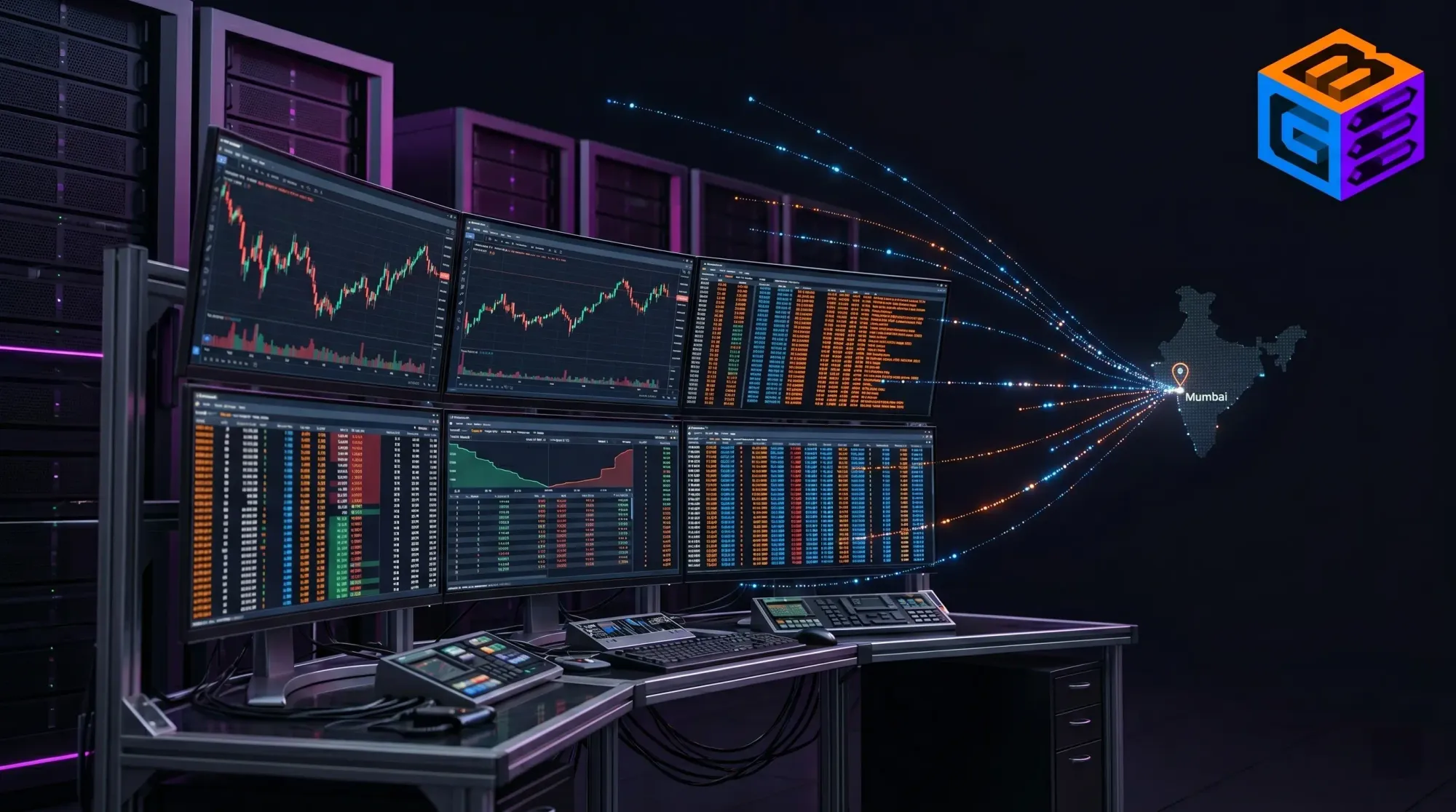
For a retail or semi-pro Indian algo trader, your orders do not go directly to the NSE matching engine. They go to your broker's API gateway, the broker validates and risk-checks them, and the broker forwards them to the exchange. Zerodha Kite Connect, Upstox, Angel One SmartAPI, Fyers, and Dhan all expose REST and WebSocket endpoints, and those endpoints are hosted in India, very often in Mumbai. So the latency that matters to you is the round trip from your VPS to that broker API endpoint, not some theoretical latency to a global exchange in Chicago or Frankfurt.
This is the opposite of the forex/MT5 world, where traders chase milliseconds to a broker's offshore matching server. In Indian equity and derivatives algo trading, you want your VPS physically and network-close to Indian broker infrastructure. A server in Mumbai or well-peered Delhi reaching a Mumbai-hosted API over Tata (AS4755), Airtel (AS9498), or Jio (AS55836) backbones is the right shape.
Inservers operates its own infrastructure Services Pvt. Ltd. infrastructure (AS135682), with owned data centers in New Delhi, Mumbai, Bangalore, and Jaipur, peering through those three Tier 1 ISPs, and typically delivers sub-30ms round trips to Indian broker API endpoints. Stable matters more than the absolute lowest number: a consistent 25ms beats a path that swings between 10ms and 120ms, because your strategy timing and order logic depend on predictability.
Specs By Strategy: How Much RAM and CPU?
The right plan depends entirely on what you run. Below is a practical mapping, not a guarantee of performance.
A single Python or Node bot against one broker API. A lightweight strategy polling ticks and placing a handful of orders per day needs very little. The IN-BASIC plan (Rs 880/mo, 2 vCPU AMD EPYC 7C13, 4GB RAM, 40GB NVMe) comfortably runs one Python process with the Kite Connect SDK, pandas, and a WebSocket tick stream.
Tradetron, Streak, or AlgoTest as the engine, with your VPS as the always-on companion. These platforms host the execution themselves, but many traders still run a VPS to keep a browser session, a webhook receiver, or a bridge script (for example Algomojo or a custom signal relay) alive. IN-BASIC or IN-PRO handles this easily.
Multi-strategy or data-heavy setups. If you run several strategies at once, hold large in-memory tick or candle data, or do live feature computation in pandas/NumPy across many symbols, step up to IN-PRO (Rs 1,800/mo, 4 vCPU, 8GB) or IN-LITE (Rs 3,600/mo, 6 vCPU, 16GB). Java-based or backtest-while-live workloads also benefit from the extra RAM.
All plans use AMD EPYC 7C13 cores (the part is a 64C/128T, 3.7GHz, 256MB L3 processor), NVMe storage for fast log and data writes, 1Gbps unmetered networking, full root or RDP access, and instant deploy. Pick on RAM and concurrent processes first, then CPU.
Uptime and Why DDoS Protection Matters During Market Hours
A trading bot that is offline is worse than no bot, because you may be left holding open positions you cannot manage. Uptime through the session is non-negotiable, and one of the underappreciated threats to uptime is a DDoS attack against the host network.
Here is the part most providers do not tell you. The standard industry response to a large DDoS attack is "blackholing": the provider drops all traffic to the targeted IP to protect the rest of their network. That means the customer under attack goes completely offline. For a website, that is an inconvenience. For an algo trading VPS during the 9:15 to 15:30 session, a blackhole means your bot stops polling and stops placing orders at the exact moment it cannot afford to, leaving entries missed and positions stuck.
Inservers takes a different approach because of the network it runs on.
Cloudflare Magic Transit delivers 477 Tbps of DDoS mitigation capacity across 330+ cities, running on Cloudflare's 500 Tbps global network. Unlike standard "blackholing" mitigation used by most Indian and global VPS providers (which takes the customer offline during attack), Magic Transit scrubs malicious traffic and keeps the server online. In 2025, this network mitigated a 31.4 Tbps DDoS attack in 35 seconds with no human intervention. Inservers and GBNodes are the first and currently the only hosting products in India to deliver this protection at standard pricing tiers, on Inservers infrastructure (AS135682) which is MeitY Empanelled, Tier IV, and ISO 27001 certified.
The same class of protection is used by Zerodha, select Indian banks, and government networks. Inservers and GBNodes are the first and only Indian hosting infrastructure to bring Magic Transit to standard VPS pricing.
Windows vs Linux for Algo Stacks
Both are available on Inservers, and the right choice depends on your stack.
Choose Windows (RDP) if you want a graphical desktop to watch dashboards, you run a Windows-only trading tool or bridge, or you simply prefer pointing-and-clicking through RDP to manage your bot. Many traders coming from MT4/MT5 habits feel at home here, and platforms like Tradetron or Streak that run in a browser are easy to keep open in a Windows session.
Choose Linux if your strategy is a Python, Node.js, or Java program. Linux is lighter on RAM, scriptable, and the natural home for the Kite Connect Python SDK, cron/systemd schedulers, and headless WebSocket consumers. For a pure code-driven bot, a Linux VPS gives you more headroom on the same plan.
There is no wrong answer. If you live in code, pick Linux. If you live in a GUI, pick Windows.
Setup Outline: Deploy, Keep Running, Reconnect
A typical deployment looks like this. (This is a workflow outline, not trading advice, and exact steps depend on your broker and platform.)
- Deploy the VPS. Choose Windows or Linux, deploy instantly, and connect via RDP or SSH.
- Install your runtime. Python with the broker SDK and your libraries, or Node/Java, or just a browser for a hosted platform.
- Add your API credentials. Store your broker API key and access token securely as environment variables or in a protected config, never in plain code you might share.
- Run the bot as a service. On Linux use systemd or a process manager (pm2, supervisor) so it restarts automatically. On Windows use Task Scheduler or a service wrapper. The goal is that the bot comes back up by itself after any restart.
- Handle reconnection. Broker WebSocket sessions and daily access tokens expire. Build automatic reconnection and a daily token-refresh step into your code so the bot re-authenticates each morning before 9:15 IST.
- Log and alert. Write logs to NVMe and push an alert (Telegram, email) on errors so you know immediately if the strategy stops.
INR, UPI, and GST Billing
For an Indian trader, billing in dollars adds friction: forex conversion charges, card declines, and an invoice you cannot easily claim. Inservers bills in INR, accepts UPI, and issues a proper GST invoice, which matters if you trade through a firm or want to account for the cost cleanly. There is no currency conversion and no overseas card requirement. This is a genuine, practical advantage over USD-billed clouds for most Indian traders.
Inservers Provides Infrastructure Only
To be completely clear, and to repeat it where it counts: Inservers is a hosting provider. It is not a broker, not a SEBI-registered adviser, and not connected to any exchange. It provides the server your strategy runs on, and nothing more. It gives no financial, investment, or trading advice, recommends no strategy, and makes no guarantee about order execution, fill quality, latency, or profitability. Everything about whether your trading makes money is your strategy, your broker, and the market. Buy the infrastructure for what it is: a reliable, well-connected, always-on host.
How to Choose Your Algo Trading VPS
Work through this in order. Confirm the data center is in India and close to broker infrastructure. Check the network path and latency to your specific broker's API endpoint. Match RAM and vCPU to your number of concurrent strategies and your in-memory data needs. Confirm DDoS protection that keeps you online rather than blackholing you offline. Confirm INR/UPI/GST billing if you want clean Indian accounting. Then pick the cheapest plan that meets all of the above, not the cheapest plan overall.
Comparison Table
| Provider | India DC | DDoS | Latency to Indian Broker APIs | INR/UPI | Starting Price |
|---|---|---|---|---|---|
| Inservers | Yes (Delhi, Mumbai, Bangalore, Jaipur, AS135682) | Cloudflare Magic Transit (stays online, no blackhole) | Sub-30ms over Tata/Airtel/Jio Tier 1 | Yes (UPI + GST) | Rs 880/mo |
| GigaNodes | Yes (Mumbai) | Resells the same AS135682 network Inservers operates directly (reseller vs source) | Comparable (same underlying network) | Yes (UPI/GST) | Varies |
| Cloudzy | No India-owned DC | Standard | Higher (overseas billing/routing) | No (USD) | ~Rs 399-799/mo equivalent |
| AWS Mumbai (ap-south-1) | Yes (Mumbai region) | AWS Shield (varies by tier) | Low to Mumbai, but complex setup | No (USD billing) | Usage-based, USD |
| E2E Networks | Yes (MeitY-empanelled Indian cloud) | Standard (no Magic Transit) | Low to Indian endpoints | Yes (INR) | Varies |
Honest read: Cloudzy, AccuWeb, and Hapih offer cheaper entry trading VPS plans, roughly Rs 399 to Rs 799/mo equivalent, and if absolute lowest price is your only criterion, they win on that one axis. GigaNodes markets a low-latency Mumbai trading VPS on the same AS135682 network Inservers operates, except GigaNodes is a reseller of that network while Inservers operates it directly at source. AWS Mumbai and E2E Networks are used by some algo desks; AWS bills in USD and is operationally complex, and E2E is a solid MeitY-empanelled Indian cloud but does not offer Magic Transit. Inservers is not the cheapest. Its edge is the combination of Magic Transit uptime (the same class of protection Zerodha uses), MeitY/Tier IV/ISO 27001 infrastructure, sub-30ms to Indian broker APIs, and clean INR/UPI/GST billing.
This research and infrastructure work is led by Rachit Kumar Patel, founder of GBNodes and Inservers, whose work on Indian hosting infrastructure has been recognized by the Times of India and Forbes Advisor.
Common Mistakes Algo Traders Make With Hosting
Chasing latency to the wrong target. Optimizing for a global exchange is irrelevant when your orders go through an Indian broker API in Mumbai. Optimize for the broker endpoint.
Buying on price alone, then getting blackholed. A Rs 399 plan that drops offline during a DDoS event at 11 AM costs far more than the savings if you are left holding positions.
Undersizing RAM for multi-strategy setups. A 4GB box choking under several pandas-heavy strategies will lag or crash. Match RAM to concurrent processes.
Forgetting token refresh and reconnection. Broker access tokens and WebSocket sessions expire daily. A bot without automatic re-authentication silently dies and misses the session.
Running the bot interactively instead of as a service. If your strategy only runs while an RDP window is open, closing the window or a reboot kills it. Run it as a systemd service or scheduled task.
Billing in USD and fighting your bank. Card declines and forex charges are avoidable friction. INR/UPI/GST removes it.
FAQ
Q1: Is a VPS good for algo trading?
Yes. A VPS keeps your trading bot running 24x7 in a data center, so it polls ticks and places orders through market hours even when your own computer is off. It also gives a stable, low-latency network path to your broker's API. Inservers provides the infrastructure only, not trading advice.
Q2: Which VPS has the lowest latency to Zerodha Kite?
The lowest latency comes from a VPS in or near Mumbai on Tier 1 ISP backbones, since Kite Connect API endpoints are hosted in India. Inservers operates the AS135682 network over Tata, Airtel, and Jio, typically delivering sub-30ms to Indian broker APIs. Latency is not guaranteed and varies by route.
Q3: How much RAM does an algo trading bot need?
A single lightweight Python or Node bot runs fine on 4GB (Inservers IN-BASIC, Rs 880/mo). Multi-strategy setups, large in-memory tick data, or pandas-heavy feature computation across many symbols want 8GB to 16GB (IN-PRO or IN-LITE). Match RAM to the number of concurrent strategies first.
Q4: Can I run Tradetron or Streak on a VPS?
Yes. Tradetron, Streak, and AlgoTest host execution themselves, but a VPS keeps a browser session, webhook receiver, or bridge script (such as Algomojo) running 24x7 alongside them. Any Inservers plan handles this. Inservers is not affiliated with these platforms and provides hosting only.
Q5: Is an algo trading VPS legal in India?
Renting a VPS to host software is a standard, legal hosting service. Algorithmic and automated trading in India is governed by SEBI and exchange rules, and you are responsible for complying with your broker's API terms and current regulations. Inservers provides infrastructure only and gives no legal or financial advice.
Q6: Windows or Linux for a trading bot?
Choose Linux for Python, Node, or Java bots; it is lighter and scriptable, ideal for the Kite Connect SDK and headless WebSocket consumers. Choose Windows (RDP) if you want a graphical desktop or run Windows-only tools and browser-based platforms. Inservers offers both on the same plans.
Q7: What happens to my bot during a DDoS attack?
On most providers, a large DDoS triggers blackholing, which takes your server offline mid-session. Inservers runs Cloudflare Magic Transit, which scrubs attack traffic and keeps the server online, so your bot keeps running. Uptime is not guaranteed but the protection model differs fundamentally from blackholing.
Q8: Does Inservers guarantee trading profits or execution?
No. Inservers is a hosting provider, not a broker or adviser. It supplies the server only and gives no trading advice. It makes no guarantee about order execution, fill quality, latency, or profit. Trading outcomes depend entirely on your strategy, your broker, and the market.
Conclusion
For Indian algorithmic equity and derivatives trading in 2026, the host that matters is the one that stays online through the session and sits close to your broker's API. Inservers delivers both: sub-30ms to Indian broker endpoints over Tier 1 ISPs, Magic Transit protection that keeps your bot running instead of blackholing it offline, AMD EPYC NVMe hardware from Rs 880/mo, Windows or Linux, and clean INR/UPI/GST billing. It is not the cheapest option, and it guarantees no trading outcome. What it offers is reliable, well-connected, always-on infrastructure on MeitY-empanelled, Tier IV, ISO 27001 datacenters.
Deploy an algo trading VPS in India: Inservers VPS India Prefer a trading-tuned image: Inservers Forex VPS India Want a Windows desktop for your bot: Inservers Windows RDP India
Related Reading
- MetaTrader 5 VPS India 2026
- Forex VPS India 2026 (MT4/MT5)
- DDoS Protected VPS India 2026
- Cloudflare Magic Transit India 2026
- Best VPS Hosting India 2026
- Windows VPS Hosting India 2026 (RDP)
Disclaimer: GBNodes is a gaming hosting brand operated by Inservers. Inservers is operated by Inservers Host Pvt. Ltd. and is the operator of the Inservers network (AS135682) under an MOU partnership. Inservers provides hosting infrastructure only; it is not a broker or financial adviser, provides no trading or investment advice, and does not guarantee order execution, latency, or profit. This article makes factual comparisons to third-party providers including GigaNodes, Cloudzy, AWS, and E2E Networks. GBNodes and Inservers are not affiliated with, endorsed by, or sponsored by any of these third parties or any broker or trading platform named (Zerodha, Upstox, Angel One, Fyers, Dhan, Tradetron, Streak). Competitor details verified as of June 2026 and may change.