

Best VPS Hosting in India (2026): What Developers, Game Servers & Businesses Actually Need..

VPS hosting in India has grown rapidly over the last few years. What was once used mostly by developers and small websites is now powering everything from production applications and automation systems to game servers, bots, and long-running services. As demand grows, so does confusion.
Many providers advertise “high-performance VPS” plans with large RAM numbers and low prices. But in real-world usage, especially in India, VPS performance depends far more on infrastructure design than on the numbers listed on a pricing page.
This is why two VPS servers with similar specifications can behave very differently under load.
Why VPS Hosting in India Is Different
India presents a unique hosting environment. While connectivity has improved significantly, VPS workloads here are affected by factors that are often overlooked:
- Oversold CPU resources on shared nodes
- Inconsistent network routing across ISPs
- Limited or reactive DDoS mitigation
- VPS platforms designed for websites, not real-time services
For workloads like APIs, background workers, game servers, or automation systems, these issues surface quickly. Applications may run fine during light usage but struggle the moment traffic or processing demand increases.
This is where understanding VPS fundamentals becomes important.
CPU Performance Matters More Than Most People Realize

One of the most common VPS mistakes is choosing plans based primarily on RAM.
While memory is important, CPU performance is usually the limiting factor for most modern workloads. This is especially true for:
- High-frequency background jobs
- Game servers and simulation workloads
- Bots and automation tools
- Real-time services and APIs
Many VPS providers oversell CPU cores heavily, assuming customers won’t use them continuously. When multiple VPS instances compete for the same physical CPU, performance drops sharply.
Symptoms of CPU contention include:
- Random slowdowns
- Delayed processing
- Inconsistent response times
- Unpredictable performance during peak hours
A VPS with fewer resources but stable CPU access often outperforms a larger VPS running on crowded hardware.
Network Quality Is About Stability, Not Just Speed
Another misconception is judging VPS quality by ping alone.
Low latency is important, but stable routing matters more. In India, routing paths can change depending on ISP congestion, peering quality, and time of day. VPS providers that rely on indirect routing or congested upstreams often experience:
- Packet loss during peak hours
- Jitter that affects real-time applications
- Unstable connections despite “good” average ping
For workloads like game servers, VoIP systems, or real-time dashboards, even small routing inconsistencies can cause noticeable issues.
Reliable VPS platforms prioritize predictable network paths and avoid aggressive oversubscription of uplinks.
DDoS Protection Is No Longer Optional

As VPS usage grows, so does exposure.
Public-facing VPS services are increasingly targeted by automated attacks, scanning tools, and traffic floods. Many entry-level VPS platforms rely on basic firewalls or rate limits that activate only after traffic reaches the server.
This approach is often too slow.
Effective protection needs to operate at the network edge, filtering malicious traffic before it consumes server resources. Without this, even moderate attacks can saturate CPU or bandwidth, causing downtime.
For businesses, developers, and communities running public services, this is no longer an edge case—it’s a real operational concern.
VPS vs Shared Hosting: The Control Factor
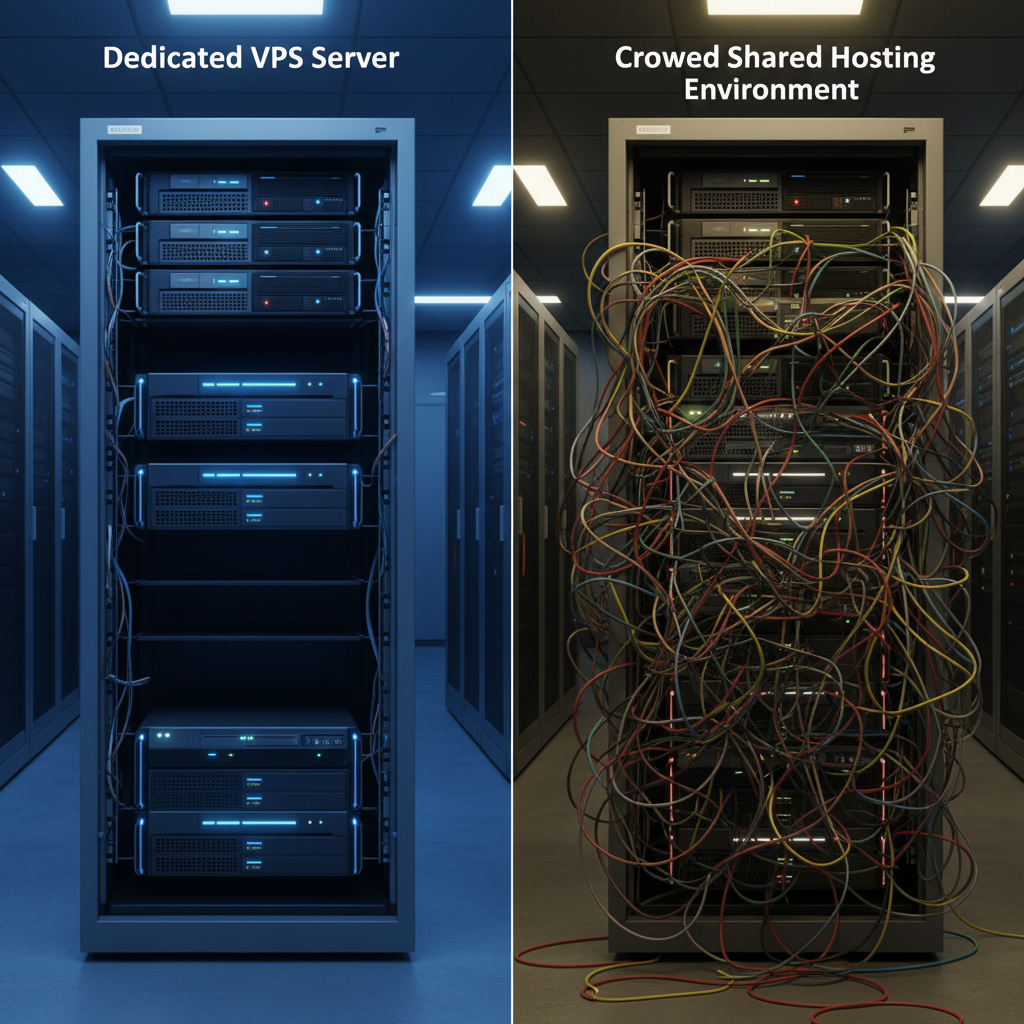
One of the main reasons people move to VPS hosting is control.
Unlike shared hosting, a VPS provides:
- Root or administrator access
- Custom OS configurations
- Control over services, ports, and background processes
This flexibility is essential for modern workloads that don’t fit into traditional hosting models.
However, control only helps when the underlying infrastructure is capable. A poorly designed VPS platform can still limit performance, regardless of access level.
The Real VPS Question in India
The key question is no longer:
“Does this VPS have enough RAM?”
 Inservers
It’s:
- Is CPU performance consistent under load?
- Is network routing stable during peak hours?
- Is traffic filtered before it reaches the server?
- Is the infrastructure designed for long-running workloads?
These factors determine whether a VPS feels reliable or constantly frustrating.
In the next part, we’ll look at when Linux VPS setups make sense, when Windows VPS (RDP) becomes the better choice, and how different use cases in India benefit from different VPS configurations.
Linux VPS vs Windows VPS (RDP): What Actually Makes Sense in India
Once people move beyond shared hosting, the next decision usually comes down to Linux VPS or Windows VPS (RDP). In India, this choice matters more than most realize, because workloads, tooling, and operational habits vary widely.
There is no universally “better” option. The right choice depends entirely on what you’re running and how you manage it.
When Linux VPS Is the Right Choice
Linux VPS setups are widely used for good reasons. They are lightweight, efficient, and well-suited for many modern workloads.
Linux VPS works best when:
- You run web applications, APIs, or microservices
- You rely on Docker, Node.js, Python, or Go
- You manage servers via SSH and automation
- Resource efficiency matters more than GUI access
Linux environments typically consume fewer background resources, leaving more CPU available for applications. For developers and backend services, this often results in better performance per core.
In India, Linux VPS setups also benefit from:
- Faster boot times
- Easier scaling
- Lower overhead on shared infrastructure
For most backend and production services, Linux remains the default choice.
Why Many Indian Users Prefer Windows VPS (RDP)
Despite Linux’s advantages, Windows VPS (RDP) remains extremely popular in India — and not without reason.
Windows VPS makes sense when:
- You rely on Windows-only software
- Your workflow depends on GUI-based tools
- Multiple admins need easy access
- You manage services manually rather than via scripts
In practice, Windows VPS is often chosen not for raw efficiency, but for operational simplicity.
Many Indian teams and server owners:
- Are more comfortable with Windows environments
- Need faster onboarding for non-technical staff
- Prefer visual monitoring and control
RDP provides direct access to the server environment, making troubleshooting, testing, and live changes easier for many users.
Performance Myths Around Windows VPS
A common belief is that Windows VPS is always slower than Linux VPS. This isn’t entirely accurate.
Performance differences depend more on:
- CPU quality and allocation
- Background load on the host node
- Storage performance
- Network stability
A well-provisioned Windows VPS on strong hardware often outperforms a poorly configured Linux VPS on oversold infrastructure.
In India, where CPU contention is common, infrastructure quality matters more than OS choice.
Choosing Based on Use Case, Not Preference
Instead of asking “Which OS is better?”, the better question is:
“What does my workload actually need?”
Examples:
- A developer running CI/CD pipelines → Linux VPS
- A business running Windows-based tools → Windows VPS
- A game or simulation server needing admin control → Often Windows VPS
- Automation-heavy workloads → Linux VPS
Problems usually arise when people choose an OS based on familiarity rather than requirements.
The Real Cost of the Wrong Choice
Choosing the wrong VPS setup doesn’t usually cause immediate failure. Instead, it leads to:
- Higher operational overhead
- Slower troubleshooting
- Inconsistent performance
- Difficult scaling later
In India’s hosting environment, these issues compound faster due to traffic patterns, ISP behavior, and oversubscription.
How to Choose the Right VPS Hosting in India (Without Regretting It Later)
By now, one thing should be clear: VPS hosting success in India is less about specs and more about consistency.
Most VPS failures don’t happen on day one. They appear weeks or months later—when traffic grows, background jobs increase, or services stay online continuously.
What Actually Separates Good VPS Providers From the Rest
When evaluating VPS hosting in India, these factors matter far more than marketing claims:
1. Consistent CPU Access
Not burst speed. Not “up to” numbers.
What matters is predictable CPU availability under sustained load. Oversold nodes will always fail here.

2. Stable Network Behavior
Good VPS providers optimize routing and avoid congested upstreams.
Stable performance during peak ISP hours is a stronger signal than low idle ping.

3. Network-Level Protection
If traffic filtering happens only after it reaches the server, protection is already too late.
Edge-level mitigation keeps services online during real-world attacks.
4. Infrastructure Built for Long-Running Workloads
Many VPS platforms are optimized for short-lived website traffic, not 24/7 services.
Databases, game servers, bots, and APIs expose weak infrastructure quickly.
Common VPS Mistakes Indian Users Make
These mistakes appear again and again:
- Choosing based on RAM alone
- Ignoring CPU contention
- Assuming “DDoS protection” is automatic
- Underestimating network instability
- Migrating only after problems become visible
Once users hit these issues, migration becomes harder, more expensive, and disruptive.
Scaling VPS the Right Way
Stable VPS growth follows a predictable pattern:
- Start with controlled workloads
- Monitor CPU and network behavior early
- Upgrade resources before saturation
- Choose platforms that allow gradual scaling
Good VPS hosting supports growth quietly.
Bad VPS hosting forces emergency decisions.
The Long-Term View
VPS hosting isn’t just infrastructure—it’s an operational foundation.
A reliable VPS:
- Reduces downtime
- Lowers admin stress
- Improves user experience
- Saves time and cost over the long term
In India’s fast-growing digital ecosystem, predictability beats raw specs every time.

Final Thought
The best VPS hosting decisions are boring in the best way possible.
No drama. No firefighting. Just systems that keep running.
If you treat VPS hosting as a long-term investment instead of a short-term cost, you avoid most of the problems others run into—and that difference compounds over time.