


Best FiveM Hosting in India (2026): What GTA RP Servers Actually Need.

FiveM roleplay servers have exploded in India over the last few years. What started as small private RP sessions has turned into full-scale communities with custom maps, heavy scripts, voice systems, and hundreds of concurrent players. With that growth comes a hard reality most server owners discover the painful way: FiveM hosting requirements are very different from regular game hosting.
Many Indian server owners assume that if a host can run Minecraft or basic VPS workloads, it can handle FiveM. That assumption is usually wrong.
FiveM servers push hardware and networks in ways that most generic hosting setups aren’t designed for. When hosting is not optimized correctly, the result is familiar to almost every RP admin in India: desync, rubber-banding vehicles, delayed voice, random crashes, and servers going offline exactly when player count peaks.
Choosing the right FiveM hosting in India is no longer optional. It directly affects gameplay quality, player retention, and the credibility of the entire RP community.
Why FiveM Hosting Is More Demanding Than It Looks
At a glance, FiveM may look like “just another game server.” In reality, it behaves closer to a real-time simulation platform than a typical multiplayer game.
A live FiveM RP server is constantly handling:
- Real-time player movement and vehicle physics
- Scripting frameworks (ESX, QBCore, custom Lua scripts)
- Database operations for inventory, jobs, housing, and economy
- Voice systems running continuously
- AI traffic, NPC logic, and map streaming
All of this happens simultaneously, and most of it is CPU-bound, not RAM-bound.
This is why many servers with “enough RAM” still lag badly once the player count increases.
The India-Specific FiveM Hosting Problem
Hosting FiveM in India comes with challenges that don’t always show up in other regions.
Network routing is the first issue. Many hosts advertise “Asia servers” but route Indian traffic through Singapore or further. On paper, the ping looks acceptable. In practice, routes fluctuate, packet loss spikes during peak ISP hours, and gameplay feels inconsistent. In RP servers, even small latency swings ruin immersion.
DDoS attacks are the second issue. FiveM servers are frequent targets, especially public RP servers. Attacks often hit during events or peak hours. Many Indian providers rely on basic firewall rules or manual mitigation, which simply doesn’t work against sustained Layer 3 or Layer 4 attacks. When protection fails, the entire server goes down.
CPU overselling is the third issue. FiveM relies heavily on strong single-core performance. Many low-cost plans place too many servers on the same CPU, which causes tick delays the moment player count rises.
Together, these problems explain why so many Indian FiveM servers feel unstable despite having “good specs” on paper.
Why CPU Performance Matters More Than RAM for FiveM

One of the most common mistakes FiveM server owners make is prioritizing RAM over CPU.
While RAM is important, FiveM performance is overwhelmingly CPU-driven. Script execution, entity updates, vehicle physics, and player synchronization all depend on how fast the CPU can process each tick.
A server with high RAM but weak or overloaded CPU will:
- Lag during peak hours
- Struggle with heavy RP scripts
- Desync vehicles and players
- Drop tick rate unpredictably
In contrast, a server with fewer resources but strong single-core CPU performance often runs smoother and more consistently.
For Indian FiveM servers, CPU quality is one of the most important hosting decisions you can make.
The Cost of Poor FiveM Hosting
When FiveM hosting fails, the damage isn’t just technical.
Players lose trust when servers lag or crash during roleplay scenes. Streamers avoid unstable servers. Staff burnout increases as admins spend more time firefighting issues than improving gameplay. Communities that could have grown into long-term RP hubs slowly fade away.
In India’s competitive RP scene, stability is part of your reputation. Hosting choices directly shape whether a server grows or stagnates.
In the next part, we’ll break down what actually defines good FiveM hosting in India, including CPU selection, DDoS mitigation, network routing, and how to evaluate hosting providers without falling for marketing claims.
What Actually Defines Good FiveM Hosting in India
FiveM servers behave very differently from standard game servers. They are closer to real-time simulation platforms than simple multiplayer setups. Because of this, many hosting providers that work fine for Minecraft or basic games fail badly when used for FiveM.
To understand what good FiveM hosting looks like in India, you need to focus on four core pillars: CPU performance, DDoS mitigation, network routing, and provider evaluation.
CPU Selection: The Real Bottleneck in FiveM
FiveM is extremely CPU-dependent.
Unlike some games that distribute load evenly across multiple cores, FiveM relies heavily on strong single-core performance. Scripts, resources, player sync, vehicle physics, and server-side logic all compete for CPU time.
This is why many FiveM servers lag even when they have:
- Plenty of RAM
- Low player counts
- “High specs” on paper
The problem isn’t memory. It’s CPU scheduling and clock speed.
What actually matters:
- Modern CPUs with high single-core clocks
- Consistent performance (no aggressive throttling)
- Low contention (not overcrowded nodes)
This is also why generic shared hosting struggles with FiveM. When multiple servers fight for CPU cycles, FiveM is usually the first to break.
Why DDoS Mitigation Is Non-Negotiable for FiveM
FiveM servers are among the most targeted game servers in India.
Public roleplay servers, especially those gaining popularity, attract:
- Random attack attempts
- Competitive disruption
- Stream-sniping related attacks
- Sustained Layer 3 / Layer 4 floods
Many hosts claim to offer “DDoS protection,” but in reality:
- Some only block traffic after it hits the server
- Some rely on basic firewall rules
- Some throttle all traffic, hurting legitimate players
This doesn’t work for FiveM.
Effective protection must happen before traffic reaches the server, at the network edge. If malicious packets hit your CPU or network interface, lag and disconnects are already unavoidable.
For Indian FiveM servers, this is critical because:
- Attacks often originate locally
- Mitigation needs to react fast
- Manual intervention is too slow
This is why experienced server owners prioritize network-level mitigation over software-based solutions.
Network Routing: Why “Low Ping” Isn’t Enough
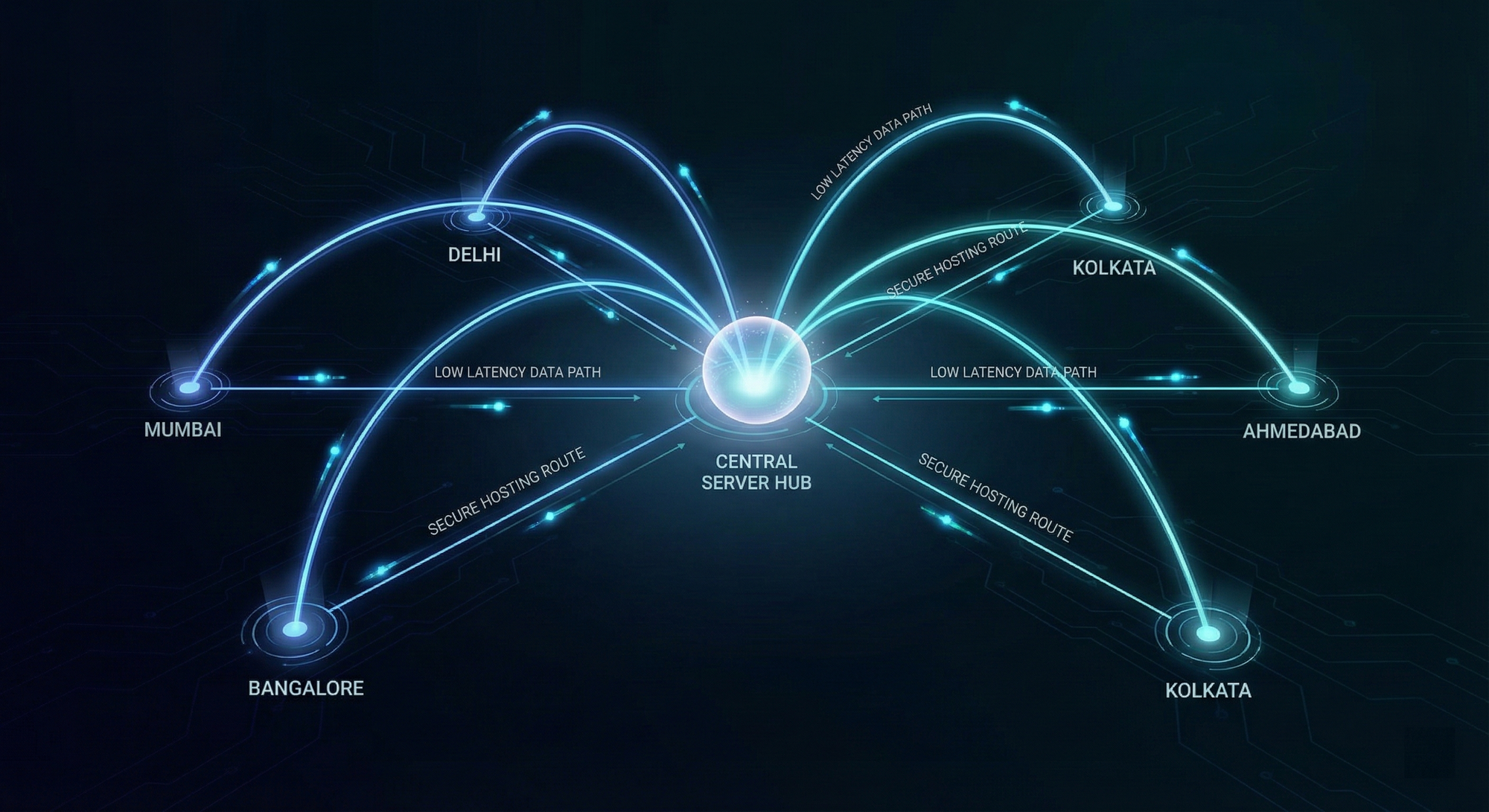
A common mistake is judging hosting purely by ping numbers.
FiveM requires stable routing, not just low latency.
Many international hosts route Indian traffic through:
- Singapore
- Hong Kong
- Europe
Even if average ping looks acceptable, real gameplay suffers due to:
- Route instability
- ISP congestion during peak hours
- Packet loss under load
For roleplay servers, this results in:
- Desync issues
- Delayed interactions
- Rubber-banding vehicles
- Poor experience during busy hours
Hosting that is designed with India-focused routing and peering performs noticeably better in real-world conditions, especially during events or high player activity.
VPS vs Game Hosting for FiveM: What Actually Works
FiveM sits in a unique position where VPS-based setups can outperform traditional game hosting, but only if done correctly.
Why VPS or RDP setups are often preferred:
- Full CPU control
- Root access for tuning
- Custom resource allocation
- Flexibility for large script-based servers
However, this only works when:
- The VPS runs on gaming-capable hardware
- CPU contention is low
- DDoS protection is handled at the network level
A poorly designed VPS will perform worse than game hosting. A well-designed one becomes the most scalable option for serious FiveM communities.
This is why many Indian server owners quietly move toward DDoS-protected VPS infrastructure instead of shared game plans.
How to Evaluate FiveM Hosting Providers Without Falling for Marketing
Marketing claims are easy. Real capability is harder to verify.
Before choosing a provider, Indian FiveM server owners should ask:
- What CPU models are actually used?
- Is performance consistent under load?
- Where does DDoS filtering happen?
- How does routing behave during peak ISP hours?
- Does support understand FiveM-specific issues?
Red flags to watch for:
- Extremely low prices with high player claims
- Vague answers about hardware
- No explanation of attack mitigation
- Support teams unfamiliar with FiveM internals
FiveM hosting is not forgiving. Problems surface quickly, and once players lose trust, it’s hard to recover.
In the next part, we’ll look at why many FiveM servers fail after initial success, how infrastructure choices affect long-term growth, and what stable Indian FiveM deployments tend to do differently once they scale beyond hobby projects.
Why Most Indian RP Servers Eventually Move to RDP / Windows VPS
If you look closely at successful Indian FiveM RP servers, a clear pattern appears over time.
They usually start on shared or basic game hosting.
Then, as player count, scripts, and complexity increase, they hit a wall.
That wall is control.
Why RDP (Windows VPS) Becomes the Natural Upgrade
FiveM servers grow in ways that basic hosting cannot handle well:
- Heavier roleplay frameworks
- Complex UI scripts
- Custom vehicle packs
- External integrations (Discord bots, databases, logging tools)
- Frequent updates and testing
At this stage, many Indian RP owners move to Windows-based VPS (RDP) setups.
Not because it’s trendy — but because it solves real problems.
With a Windows VPS (RDP), server owners get:
- Direct access to the OS (no panel limitations)
- Full control over CPU usage and priorities
- Better compatibility with FiveM tools and frameworks
- Easier debugging and live monitoring
- Stable handling of large script-based servers
This is why RDP-based setups dominate among mid-to-large RP servers in India.
Performance Isn’t Just Hardware — It’s Control
Many people assume RDP is only about convenience.
In reality, it’s about performance consistency.
On controlled Windows VPS environments:
- CPU scheduling is predictable
- Background noise is minimal
- Server ticks remain stable during peak hours
- Resource-heavy scripts behave more reliably
This matters a lot for RP servers where:
- 50–100 players are active simultaneously
- Vehicles, jobs, and NPCs are constantly synced
- Lag breaks immersion instantly
A well-provisioned Windows VPS often feels smoother than cheaper “game hosting” plans, even when specs look similar on paper.
The Critical Difference: DDoS-Protected VPS vs Normal VPS

Here’s where many Indian RP servers still make mistakes.
They move to a VPS — but without proper DDoS protection.
That’s dangerous.
FiveM RP servers attract attention.
Attacks are common, especially during events or growth phases.
A VPS without network-level protection can:
- Freeze under traffic floods
- Disconnect all players instantly
- Require manual intervention
- Go offline repeatedly during attacks
This is why experienced server owners look for DDoS-protected VPS infrastructure, not just “cheap RDP”.
When protection exists at the network edge, the server:
- Keeps running during attacks
- Maintains stable ping
- Avoids CPU and bandwidth saturation
For RP communities, this stability directly translates to player trust and retention.
How Serious Indian RP Servers Scale Safely

Most long-running Indian RP servers follow a similar path:
- Start small on basic hosting
- Move to Windows VPS (RDP) for control
- Ensure strong DDoS protection before public exposure
- Scale CPU and resources gradually as scripts grow
They don’t chase flashy marketing claims.
They prioritize predictable performance and control.
This is also why many such servers quietly operate on VPS-based infrastructure rather than advertised “RP hosting plans”.
In the next part, we’ll connect everything together and explain how Indian FiveM server owners can choose the right setup based on their server size, what mistakes to avoid during scaling, and how infrastructure decisions directly impact long-term success.
Putting It All Together: Choosing the Right FiveM Setup in India
At this point, the pattern should be clear.
Most FiveM RP servers in India don’t fail because of bad ideas or weak communities.
They fail because the infrastructure doesn’t scale with ambition.
Here’s the simplest way to think about it:
- Small / private RP servers (10–20 players)
→ Can start on basic game hosting, but only short-term - Growing public RP servers (30–60 players)
→ Need stronger CPU performance, better routing, and more control - Established RP servers (60+ players, events, stream exposure)
→ Almost always require Windows VPS (RDP) with reliable DDoS protection
Trying to run a serious RP server on underpowered or poorly protected hosting usually leads to:
- Random lag during peak hours
- Crashes during events
- Downtime during attacks
- Players leaving silently
Why Infrastructure Decisions Shape Server Reputation
In RP servers, immersion is everything.
Players forgive bugs.
They don’t forgive lag, freezes, or disconnects.
Once a server gains a reputation for instability, it’s very hard to recover — no matter how good the scripts or roleplay rules are.
This is why experienced Indian server owners:
- Upgrade infrastructure before problems become visible
- Prioritize stability over flashy specs
- Choose setups that allow scaling without migration chaos
Good infrastructure doesn’t make a server popular.
But bad infrastructure can kill one instantly.
The Long-Term View for Indian FiveM Servers

As FiveM continues to grow in India, expectations are rising fast.
Players now compare:
- Tick stability
- Ping consistency
- Event reliability
- Stream smoothness
Servers that treat hosting as a long-term foundation, not a temporary expense, are the ones that survive and grow.
Whether a server runs on game-optimized hosting or transitions to Windows VPS (RDP), the goal is the same:
predictable performance, control, and protection under real-world conditions.
That’s what separates short-lived RP projects from communities that last for years.